
QuarkView Security Learning Center. This buyer guide is written for importers, distributors, installers, and project teams comparing real surveillance products, not only catalog claims.
Use it to connect OEM security camera manufacturing, ODM customization, private label packaging, and production approval with practical procurement, installation, support, and reorder decisions.
In international security projects, OEM security camera decisions are rarely about a single datasheet. Importers, distributors, installers, and project buyers need to know whether the claimed camera performance, recorder capacity, firmware behavior, packaging method, export documentation, and after-sales communication will remain consistent after the sample stage. This QuarkView CCTV buyer guide explains understanding when to buy standard models, private-label models, or customized manufacturing services in practical procurement language for B2B buyers.
The same evaluation logic applies whether the immediate purchase is an OEM security camera, an IP camera for a pilot site, a PoE camera for a wired retrofit, a PoE security camera system for a chain store, an NVR security system for centralized recording, an outdoor security camera for perimeter coverage, a business surveillance system for operations, or wholesale security camera kits supplied by a CCTV camera manufacturer or security camera supplier.
The purpose is to help buyers compare supplier evidence, product claims, and project conditions before committing to bulk production. International B2B platforms such as Alibaba International Station make it easy to find many offers, but the buyer still needs a disciplined review method that connects specification sheets with installation reality, local compliance, and support needs.
How it works
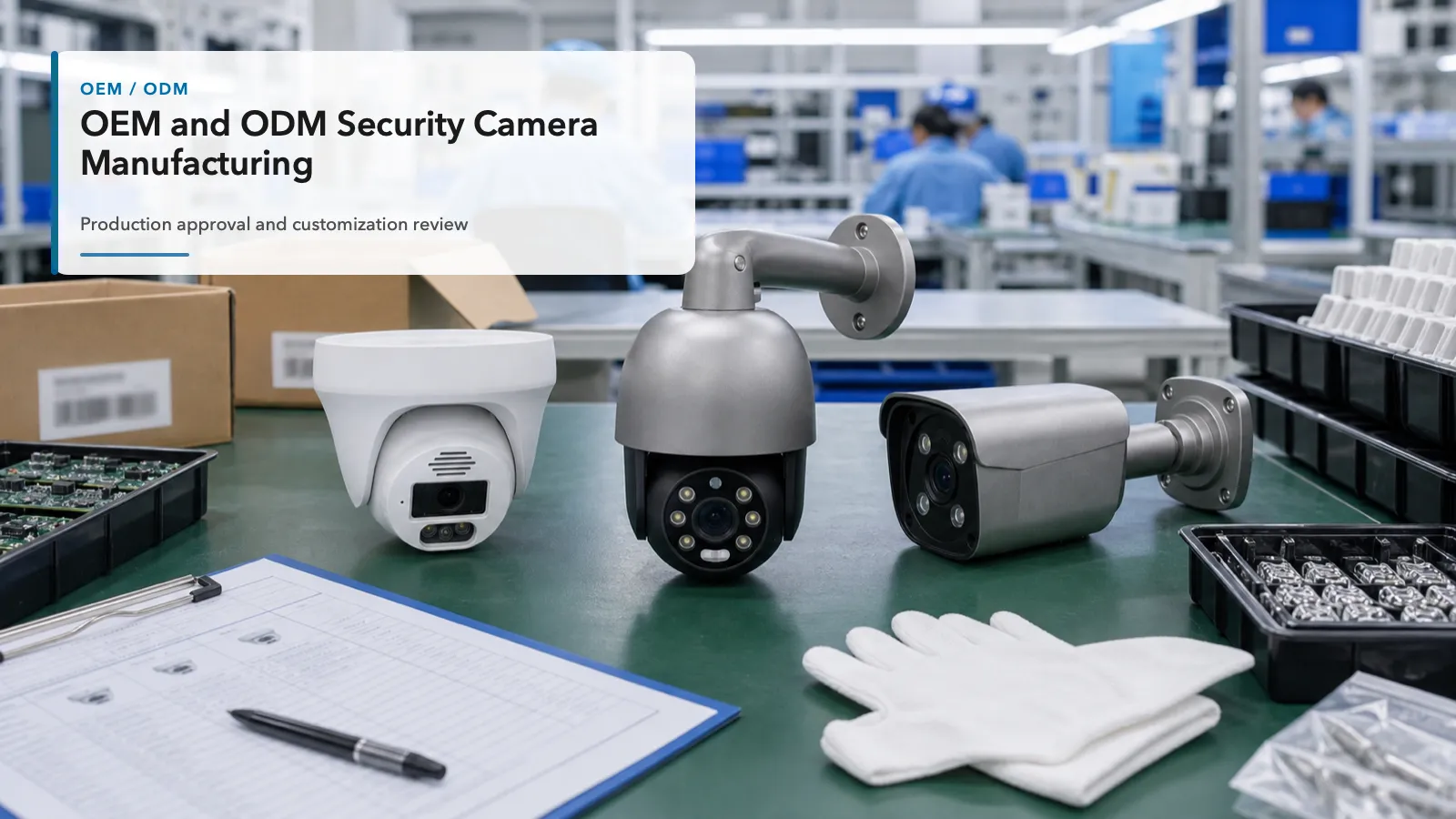
OEM and ODM are often used loosely in security camera sourcing, so buyers should clarify the scope before discussing price. In a typical OEM security camera arrangement, the buyer may use a supplier's existing product platform with private label, packaging, language files, and minor configuration changes. In an ODM arrangement, the supplier may design or significantly modify hardware, enclosure, firmware, or software experience for the buyer's target channel.
The engineering difference matters because customization changes risk. A simple logo on an app splash screen is different from a new enclosure tool, new lens angle, modified IR board, revised PoE budget, or NVR firmware integration. When customization touches imaging, power, thermal design, wireless modules, or cybersecurity functions, the buyer should expect additional validation time and clearer documentation.
Buyers also need to understand ownership. Some suppliers retain the platform, firmware, and tooling while granting the buyer branding rights. Others can support dedicated model numbers, reserved channel protection, packaging exclusivity, or custom firmware branches. The contract should state who owns artwork, firmware configuration, mobile app publishing rights, cloud account data, test reports, and any certification documents created for the project.
An OEM or ODM project should not bypass normal product validation. The buyer still needs sample testing, aging tests, network checks, mobile app checks, ONVIF validation, NVR recording review, weatherproof evaluation, and packaging inspection. Customization can create new faults in an otherwise stable IP camera or PoE security camera system, especially when labels, manuals, firmware defaults, or accessories are changed at the same time.
A useful technical review connects the camera layer, recorder layer, network layer, application layer, packaging layer, and service layer. If one of these layers is weak, the buyer may receive hardware that appears attractive in a quotation but creates avoidable field cost. Procurement teams should therefore combine datasheet review, sample testing, supplier questioning, and document checks instead of treating any single source of information as complete.
Traceability is also part of technical control. Buyers should keep a folder for approved quotations, sample photos, firmware screenshots, test videos, label proofs, packing lists, conformity documents, and supplier corrections. This record gives the purchasing team a practical reference when production questions arise, and it helps after-sales staff explain whether a reported issue is a product fault, installation condition, configuration choice, or documentation gap.
Features to compare
The following concepts give buyers a practical vocabulary for comparing offers. They can be adapted into a request-for-quotation sheet, sample-test report, supplier audit form, or internal approval memo.
OEM scope: Usually covers branding, packaging, language, model naming, and selected configuration changes on an existing platform.
ODM scope: Usually involves engineering design, tooling, component selection, firmware work, or a product variation built for a defined market requirement.
Minimum order quantity: Lower customization can often be supported at a smaller quantity. Enclosure tooling, app work, or certification work normally requires a larger and more stable forecast.
Intellectual property: Artwork, manuals, packaging files, firmware settings, and mechanical designs should have clear ownership and usage rights before production.
Lifecycle control: The buyer should know how long the platform will remain available, how component changes are communicated, and how firmware updates are maintained.
Agree models, documentation and order terms
A QuarkView-style supplier evaluation checklist should convert every important claim into evidence. For example, a claim about compatibility should lead to profile details and a test result; a claim about weather resistance should lead to enclosure evidence and installation guidance; a claim about warranty should lead to a written process, not only a sales message.
The buyer should also assign ownership inside the purchasing team. One person can review commercial terms, another can check technical evidence, and another can confirm packaging, labeling, and import documents. This prevents a common sourcing gap where every participant assumes another person has checked the details. A short approval record with dates, sample identifiers, supplier answers, and open questions is often enough to make later decisions more orderly.
Define whether the project needs a standard model, a private-label model, or engineering development. Each path has a different timeline, cost structure, and validation burden.
Request a customization matrix covering logo, carton, model number, web interface, app name, firmware defaults, accessory set, language, and certification labeling.
Confirm whether the supplier can provide neutral packaging samples and print proofs before mass production. Packaging errors can delay customs clearance and distributor launch plans.
Ask whether the same platform is sold to multiple markets under different labels. That may be acceptable, but channel conflict should be understood before building a private-label catalog.
Make pilot production part of the schedule when the project includes firmware, tooling, or special packaging. A pilot run helps detect issues before the bulk order is committed.
Common Applications
The decision model can be used in several channel and project environments. The buyer should adjust the depth of review according to order value, customer risk, installation complexity, and local legal responsibilities.
Regional distributors launching branded wholesale security camera kits with matched cameras, NVRs, cables, signs, and quick-start guides.
Retail channels that need private-label packaging, barcode rules, language localization, shelf-ready cartons, and consistent accessory presentation.
Installer brands that want a defined product line for small business surveillance system projects without developing hardware from zero.
Project buyers who require specialized enclosure color, lens angle, mounting hardware, or firmware defaults for a repeat deployment environment.
Common Problems
Common problems usually come from unclear requirements, incomplete evidence, or assumptions that are not tested before production. The following issues should be reviewed before deposit, inspection, or shipment release.
Logo approval delays: Freeze artwork early and require supplier proof files before the packaging supplier starts mass printing.
App ownership confusion: Clarify whether the app is shared, white-labeled, or buyer-owned, and whether app store accounts are included.
Certification mismatch: Check whether reports cover the customized configuration, model name, wireless module, power supply, and label format.
Firmware branch drift: Document the exact firmware version used in samples and require change approval for production.
Tooling assumptions: Do not assume mold cost creates exclusive ownership unless the contract states exclusivity and maintenance responsibilities.
FAQ
Is OEM only about adding a logo?
No. Logo work is common, but OEM can also include packaging, labels, language, default settings, and model naming.
When does a project become ODM?
It becomes ODM when the supplier is expected to design or modify hardware, enclosure, firmware, or other engineering elements for a specific requirement.
Can an importer start with OEM and move to ODM later?
Yes. Many buyers begin with a stable platform, then customize after sales volume and technical requirements become clearer.
Who should own certification documents?
The contract should define who may use test reports, declarations, labels, and model names. Market access can be affected if this is unclear.
How long does private-label setup take?
Simple branding may take weeks. Tooling, firmware work, app localization, or new certifications can extend the timeline substantially.
Summary
For OEM security camera, a balanced decision considers technical fitness, supplier discipline, documentation, service process, and the buyer's own channel requirements. A lower unit price is useful only when the complete system can be installed, supported, reordered, and explained to customers with confidence.
The final approval should therefore include both the first order and the reorder plan. Buyers should know how repeat orders will be checked, how obsolete models will be communicated, and how support teams will recognize differences between old and new batches. That lifecycle view is especially important for distributors and installers who must support installed systems long after the invoice has been paid.
As part of the QuarkView security camera knowledge base, this article treats procurement as a repeatable risk-control process. Buyers who document requirements, test samples carefully, verify claims, and plan after-sales handling are better prepared to build reliable CCTV sourcing programs without relying on aggressive promotional language.
Plan Your Security Camera Project With QuarkView
QuarkView helps international buyers review OEM security camera manufacturing, ODM customization, private label packaging, and production approval before committing to samples, bulk production, private-label packaging, or CCTV kit distribution.
Explore QuarkView security camera systems or contact QuarkView for project and volume inquiry support.
Related QuarkView Planning Resources
For the next planning step, compare Private Label Security Camera Systems: What Buyers Should Know, How to Choose a Security Camera Supplier for International Projects, CCTV Product Certification Basics for International Buyers, Common Mistakes When Buying CCTV Systems from Overseas Suppliers, How to Choose Security Camera Kits for Retail or Distribution. These related guides connect product selection, placement, recording, installation, and long-term reliability decisions.
Related QuarkView Collections
Reference Sources
The following public sources were used as background references for standards, conformance, compliance, and cybersecurity concepts relevant to international surveillance procurement.
ONVIF conformant products database and conformance guidance. https://www.onvif.org/conformant-products/
IEEE 802.3bt-2018 Power over Ethernet over four pairs. https://standards.ieee.org/standard/802_3bt-2018/
NIST IR 8259A IoT Device Cybersecurity Capability Core Baseline. https://csrc.nist.gov/pubs/ir/8259/a/final
UL Solutions overview of IEC 62368-1 testing and certification. https://www.ul.com/services/iec-62368-1-testing-certification
European Commission Your Europe CE marking requirements. https://europa.eu/youreurope/business/product-requirements/labels-markings/ce-marking/index_en.htm
eCFR 47 CFR 2.1204 import conditions for radio frequency devices. https://www.ecfr.gov/current/title-47/chapter-I/subchapter-A/part-2/subpart-K/section-2.1204