
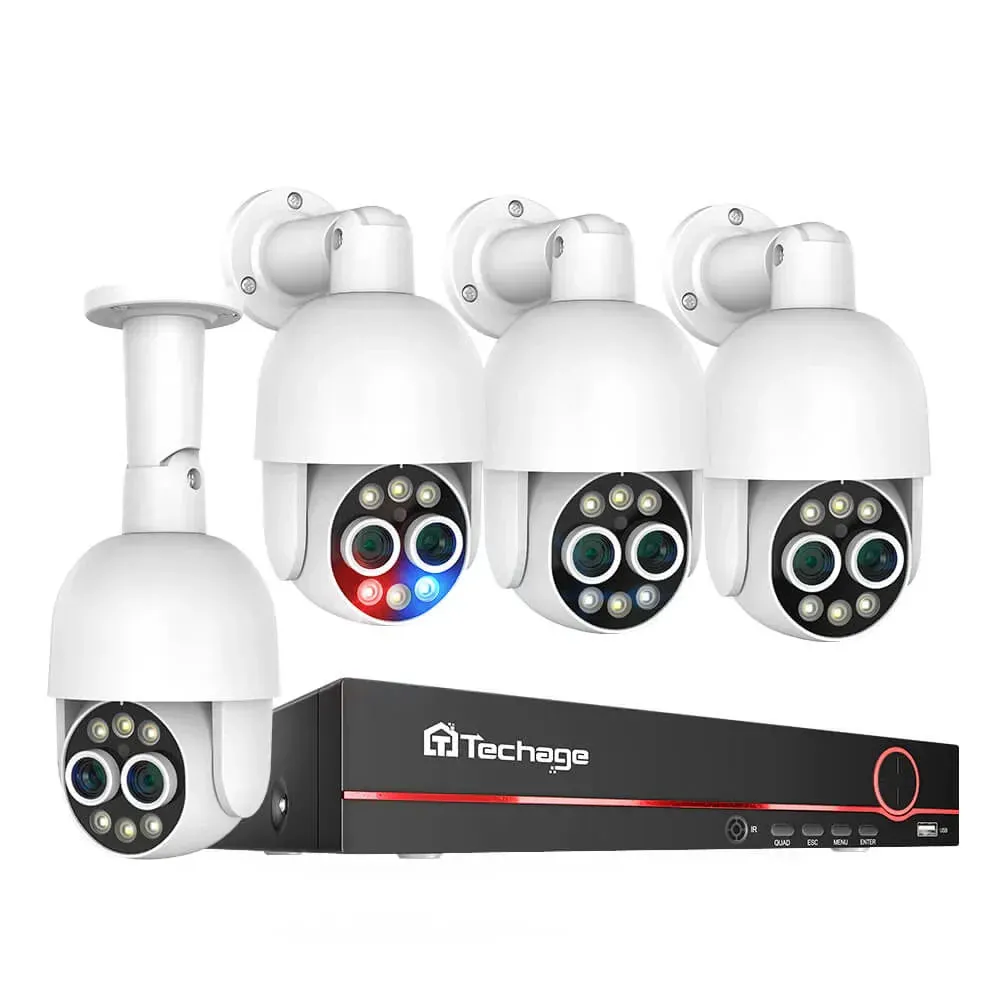
A dual lens security camera is a surveillance camera that uses two optical channels in one housing. Each channel normally includes its own lens, image sensor, image signal processing path, and video stream. The two channels may be used side by side to create a wide panoramic image, or they may be used with different optical purposes, such as one wide-angle overview lens and one telephoto lens for close detail. In professional CCTV camera projects, this design is often used when one standard security camera cannot provide both scene awareness and identification detail from the same mounting point.
The technology is common in modern IP camera products, outdoor security camera designs, and PoE camera deployments because one network cable can often power and connect the entire unit. In a PoE security camera system, the installer can sometimes replace two separately mounted cameras with one dual-lens device, reducing mounting work, cable routes, weatherproof junction boxes, and NVR channel count. The benefit is not automatic, however. A dual lens security camera must still be matched to the scene, recording platform, lighting, and evidence requirements.
The practical question is simple: does the second lens solve a real coverage problem, or does it only make the specification sheet look better? Buyers, installers, and product researchers need to compare dual-lens cameras with single-lens cameras, panoramic cameras, PTZ cameras, and standard wired security camera layouts before choosing a design.
Plan this project
Use this article to define the requirement, then compare it with Compare QuarkView PTZ and multi-lens cameras or contact QuarkView for project-level guidance.
Related planning guides
For a fuller dual-lens camera decision, pair the optical discussion here with coverage and lighting guides that explain where a second lens creates real value. Start with security camera lens basics, then compare camera placement planning and infrared vs white light camera choices before finalizing the layout. For a deeper operational layer, keep AI surveillance trends in the planning path.
When the guide turns into a product shortlist, QuarkView buyers can compare PoE camera systems, AI camera systems, single PoE cameras based on coverage area, cable path, recording needs, and installation environment.
How it works
A traditional security camera has one lens aimed at one area. The lens projects a scene onto one image sensor, and the sensor converts the light into an electronic image. The camera then compresses the image into a video stream, usually H.264 or H.265, and sends it to a recorder, VMS, cloud platform, or mobile app. This simple design works well when the desired field of view, distance, and detail level are all compatible with one lens.
The problem is that field of view and detail compete with each other. A wide lens covers more area, but each person, vehicle, or object occupies fewer pixels. A narrow or telephoto lens provides more pixels on the target, but it covers less area and may miss activity outside the frame. A dual lens security camera addresses this tradeoff by using two lens-sensor channels instead of one.
Most products fall into a few patterns. The first is the dual panoramic design. Two wide-angle lenses face adjacent directions, often left and right, and the camera processor combines or presents the images as a broad view. Some models create a stitched 180-degree scene. Others provide two independent views that can be adjusted separately. This design works well for building fronts, yards, loading docks, parking entrances, and long corridors where blind spots matter.
The second configuration is the wide-plus-telephoto design. One lens provides the broad overview, while the second lens captures a closer view. The close view may be fixed, motorized, or linked to object tracking. This type is helpful when operators need to see the entire scene and still capture face, package, or vehicle detail. It can also reduce the need to choose between a general overview camera and a dedicated identification camera.
The third configuration combines a fixed overview lens with a PTZ or tracking lens. The overview channel watches the whole scene and can guide the zoom channel toward a region of interest. In professional systems, this approach is often described as combining situational awareness with detail capture. The wide channel helps avoid the classic PTZ problem: when a PTZ camera zooms into one target, it is no longer watching the rest of the area. With two channels, the wide view remains available while the zoom view investigates a target.
Some dual-lens products use the two lenses for image fusion rather than separate scene coverage. One optical path may be optimized for visible light and another for low-light support, or one image may assist with depth estimation. In mainstream security camera buying, though, most decisions still come down to two jobs: panoramic coverage or wide-plus-detail coverage.
From a system perspective, buyers should understand how the camera appears to the NVR security system. Some dual-lens cameras use one IP address but provide two or more video streams. Some recorders treat each lens as a separate channel. Some display a stitched view as one stream and the individual lenses as additional streams. A third-party NVR may show the main stream correctly but fail to display substreams, audio, metadata, or smart events if protocol support is incomplete. ONVIF compatibility can help with basic video interoperability, but it does not guarantee that every manufacturer-specific feature will be available.
Bandwidth and storage also require planning. A dual-lens IP camera may encode two high-resolution streams at the same time. A 4 MP plus 4 MP dual-lens camera, for example, may create storage demand similar to two 4 MP cameras unless it uses an efficient combined stream or lower frame rates. H.265, smart codec modes, event recording, and carefully selected frame rates can reduce storage, but the project designer should calculate retention based on actual stream settings rather than only camera resolution.
Night performance needs its own check. If both lenses operate after dark, each optical channel needs suitable illumination. A night vision camera using infrared LEDs may provide black-and-white images in darkness. A white light camera may provide color at night but creates visible illumination that may affect people nearby. In a dual-lens outdoor security camera, the illumination must match both fields of view. A spotlight that works for a narrow lens may not evenly illuminate a wide panoramic view, and IR reflection from a wall or soffit can affect one lens more than the other.
Features to compare
The main concept is dual optical coverage. Two lenses allow the camera to collect information from two perspectives, two focal lengths, or two adjacent viewing directions.
Field of view is central to evaluation. A panoramic dual-lens camera may reduce blind spots, while a wide-plus-telephoto camera may improve target detail. Buyers should compare horizontal field of view, vertical field of view, and mounting height.
Pixel density matters more than headline resolution. A wide 8 MP image can still have poor identification detail if a face or license plate is too far away. The useful question is how many pixels cover the target at the required distance.
Image stitching may create a single wide image, but stitching quality depends on lens alignment, overlap area, distance to objects, and processor design. Nearby objects crossing the stitch line may appear stretched or duplicated on some systems.
Stream handling affects compatibility. The camera may output one stitched stream, two separate lens streams, or both. NVR channel licensing, mobile app display, and third-party VMS integration should be verified before purchase.
Power and network design still need checking. Many dual-lens units are PoE cameras, but power draw may be higher than a simple fixed camera, especially with IR, white light, heater, motorized lens, speaker, or AI processing enabled.
Analytics can be more useful but also more complex. A wide view can support intrusion, line crossing, human detection, vehicle detection, or area monitoring. The installer must configure detection zones carefully so the camera does not generate unnecessary alerts from roads, trees, reflections, or distant motion.
Check viewing distance and recorded detail
Begin with the job, not the camera type. If the goal is simply to cover a large open area, a dual panoramic camera may be suitable. If the goal is to identify people at a gate while still monitoring the whole driveway, a wide-plus-telephoto dual lens security camera may be better. If the goal is active tracking, a fixed-plus-PTZ design may be worth considering.
Ask whether the camera is replacing one camera or two. A dual-lens unit is not always a direct substitute for two physically separated cameras. If the two required views are in different locations, one dual camera cannot solve the geometry problem. It works best when both views are useful from one mounting point.
Work out the required detail level. For general awareness, a wide view may be enough. For evidence, identification, or license plate capture, the lens must provide adequate pixel density at the target distance. In many projects, a wide panoramic camera is paired with a separate narrow camera at doors, gates, or other choke points.
NVR compatibility needs testing before installation. Ask whether the recorder supports the camera model, all lens channels, main and sub streams, smart events, audio, and playback. If the project uses mixed brands, test ONVIF compatibility and confirm whether the product is listed as conformant for the relevant profile and firmware version.
Estimate bandwidth and storage. A dual-lens device can behave like two cameras from a storage perspective. Consider resolution, frame rate, compression, bitrate control, recording mode, and retention days. A PoE security camera system with several dual-lens devices may require a larger switch uplink and larger hard drives than expected.
Match the housing to the environment. For outdoor security camera use, check ingress protection, operating temperature, vandal rating, sun exposure, mounting bracket options, and cable sealing. A camera with two lenses also has two optical windows or one larger window that must remain clean.
Evaluate night performance realistically. A night vision camera specification may list IR range, but real results depend on reflectivity, mounting angle, ambient light, weather, and scene depth. Wide panoramic views are especially sensitive to uneven illumination.
Common Applications
Dual-lens cameras are frequently used at building entrances where a single mounting point must watch both the door area and the approach path. The wide channel captures context, while the detail channel can focus on faces or packages.
Parking lots and driveways benefit from broad coverage. A dual panoramic camera can reduce side blind spots, while a second lens may provide better vehicle detail at the entry lane.
Retail stores use dual-lens IP camera systems to monitor aisles, checkout areas, and customer flow. One device may cover two directions from a ceiling corner or capture a broad view behind a counter.
Warehouses and loading docks often require both wide scene awareness and specific dock-door monitoring. A dual-lens outdoor security camera can watch forklift movement and loading activity from one location.
Residential applications include front yards, gates, garages, and side passages. A wired security camera with dual lenses may reduce the number of visible devices on a home exterior.
Common Problems
One common problem is expecting one dual-lens device to solve every blind spot. The camera still sees only from its mounting position. Walls, columns, vehicles, shelving, and landscaping can still block the view.
Another issue is poor detail in wide panoramic mode. Buyers may see a large field of view and assume it captures more evidence. In reality, the wider the view, the fewer pixels are available per object at the same distance.
Compatibility problems can occur when the NVR displays only one channel, fails to record the stitched view, or does not receive smart events. This is especially relevant when mixing brands.
Night glare and reflection are also common. IR light can reflect from eaves, walls, nearby signs, raindrops, dust, or the edge of a housing. A two-lens layout may make the problem appear on only one side of the image.
Storage use may be underestimated. Dual streams, high resolution, high frame rate, and constant recording can consume NVR storage quickly.
FAQ
Is a dual lens security camera the same as a 360-degree camera?
No. Some dual-lens cameras create a very wide panoramic view, but not every dual-lens model is 360 degrees. Many are 180-degree designs or wide-plus-detail designs.
Does a dual-lens camera use one NVR channel or two?
It depends on the camera and recorder. Some systems record a stitched stream as one channel. Others treat each lens as a separate channel. Confirm this before purchase.
Is dual lens better than PTZ?
It depends on the job. PTZ is strong for operator-controlled zoom and tracking, while dual lens is strong for keeping overview coverage while adding another view. Some designs combine both concepts.
Can a dual-lens camera work in a PoE security camera system?
Yes, many dual-lens IP cameras are PoE cameras. Check the power class and switch power budget because dual-lens devices may consume more power than basic fixed cameras.
Will ONVIF compatibility guarantee all dual-lens features?
No. ONVIF compatibility can help with standard video streaming and supported profile features, but stitching, AI events, two-way audio, and special display modes may require manufacturer-specific integration.
Is a dual-lens camera good for license plate capture?
Only if one lens provides the correct focal length, angle, shutter settings, illumination, and pixel density for the plate distance and vehicle speed. A wide panoramic lens alone is usually not enough for reliable plate evidence.
Summary
A dual lens security camera can reduce blind spots and combine wide scene awareness with closer detail. It is especially useful in IP camera and PoE camera systems where one cable can support a multi-channel device. It still needs the same planning as any other CCTV camera: field of view, pixel density, night performance, NVR compatibility, storage, and mounting geometry. Treat it as one tool in a planned camera layout, not as a universal replacement for every camera on the site.
How QuarkView Can Help
Explore related QuarkView products or contact QuarkView for project support, volume inquiries, and system planning help.
Reference Sources
- ONVIF Profile T and profile documentation: https://www.onvif.org/profiles/profile-t/
- ONVIF conformance guidance: https://www.onvif.org/profiles/conformance/
- Axis panoramic camera white paper and learning material: https://whitepapers.axis.com/en-us/panoramic-cameras
- Axis article on panoramic camera use cases: https://newsroom.axis.com/blog/panoramic-cameras
- Hikvision TandemVu multi-lens technology overview: https://www.hikvision.com/us-en/core-technologies/multi-lens-synergy/tandemvu-technology/
- TP-Link Tapo dual-lens camera educational article: https://www.tapo.com/us/news/841/