
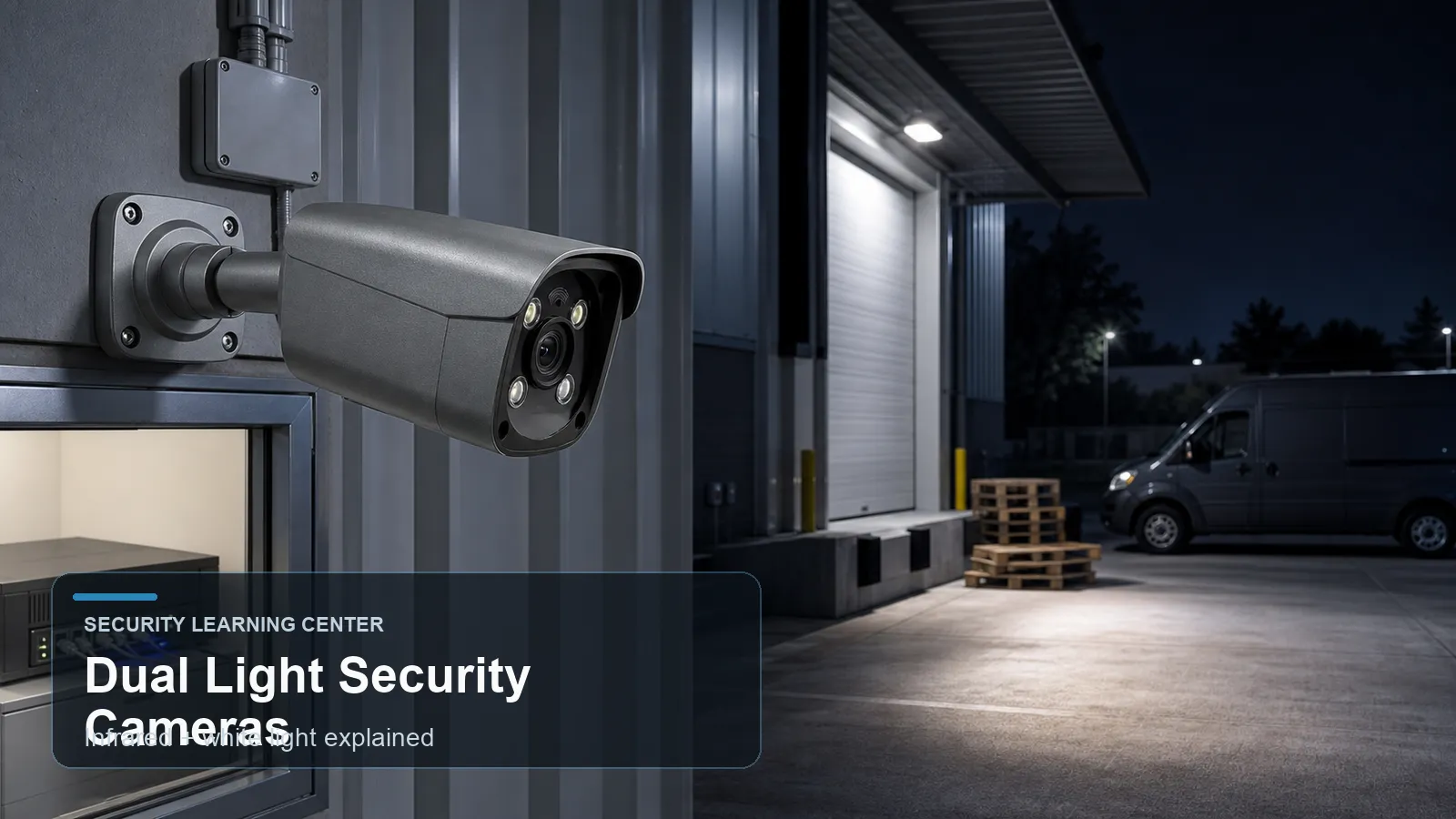
Introduction
This QuarkView security camera education article is part of the QuarkView AI surveillance knowledge base and focuses on the main keyword 'dual light security camera' as a practical design topic rather than a product slogan.
A dual light security camera combines infrared illumination and visible white light in one camera. Instead of choosing only black-and-white IR or always-on color lighting, the camera can use IR for quiet monitoring and switch to white light when a person, vehicle, or event rule requires color detail. The useful question is not whether the feature sounds advanced, but whether it improves evidence, alerts, and daily operation at a real site.
Readers comparing a CCTV camera, IP camera, PTZ camera, PoE camera, NVR security system, outdoor security camera, night vision camera, smart detection camera, or AI surveillance camera can use this guide to separate feature language from surveillance planning.
The article explains how dual-light infrared and white-light illumination works, where it helps, where it can fail, and how buyers should test it before relying on it for homes, small businesses, warehouses, parking lots, gates, and commercial properties.
Main Technical Explanation
In the simplest mode, a dual light camera behaves like a normal IR night vision camera until an event occurs. The camera records a monochrome low-light image with infrared LEDs. When smart detection recognizes a human or vehicle, the white light turns on and the camera captures color footage for the event interval.
This design tries to solve a common conflict in CCTV camera planning. Operators want the low nuisance level of IR but also want color evidence when an incident happens. A dual light security camera can reduce the number of hours when visible light is on while still giving color during higher-value moments.
The switching logic is important. Some cameras use basic motion, while others use AI object classification. A system that turns white light on for every insect, branch, or rain streak can become annoying and may reduce trust in alerts. A smart detection camera should be configured with zones, minimum object size, schedules, and event linkage rules.
Dual light performance also depends on camera placement. White light aimed into glass, polished vehicles, light-colored walls, or wet pavement may create glare. IR aimed through a dome or near a soffit can reflect back. The installer should test both illumination paths after dark and adjust the angle before signoff.
Every advanced camera feature sits inside a complete video chain. The lens forms the image, the sensor captures light, the processor controls exposure and compression, the network carries video, and the recorder stores evidence. If one part of that chain is weak, the advertised feature may still produce poor operational results.
A useful design starts with a target behavior. The camera might need to show a person entering a doorway, a vehicle crossing a gate, a forklift moving through a warehouse aisle, or an after-hours presence in a restricted zone. The camera feature should support that behavior, not distract from it.
For PoE surveillance, the network side is also part of the design. Cable length, switch power budget, recorder bandwidth, camera stream settings, time synchronization, account permissions, and firmware maintenance all influence reliability. A feature that works in the camera web page may not be fully searchable in the NVR unless compatibility is verified.
Maintenance should be planned before the camera is installed. Lenses and domes need cleaning, vegetation and signage can move into the scene, firmware may change analytics behavior, and seasonal lighting can shift exposure. A quarterly review of live view, event clips, storage health, user accounts, and exported evidence keeps advanced functions useful after the first installation week.
Key Features or Concepts
- IR monitoring keeps the scene less visibly lit during normal night conditions.
- White light can activate during an event to capture color details.
- Human and vehicle detection can reduce unnecessary white-light triggers.
- Schedules can prevent deterrence lighting from activating during normal business activity.
- Some systems link white light to siren, voice prompt, push alert, or NVR event recording.
- IR range and white-light range are different and should not be treated as the same distance.
- A dual light IP camera may expose separate stream, illumination, and event settings.
- Compatibility with an NVR security system should be confirmed for event metadata and playback search.
Buying Considerations
In a QuarkView-style surveillance planning example, the buyer first marks the real security boundary, then chooses whether dual-light infrared and white-light illumination improves that boundary. For example, a gate, loading dock, side yard, lobby, or parking lane may each need a different camera angle and rule design.
Confirm whether the camera can run IR only, white light only, or smart hybrid mode. These modes affect neighbors, signage, evidence quality, and storage review.
Check whether the white light is steady, flashing, adjustable, or tied to active deterrence rules. Stronger light is not always better.
Ask whether AI events are generated at the camera edge or by the recorder. This affects response speed, compatibility, and whether third-party NVRs receive the right event data.
Review the mounting area for reflective surfaces before choosing a dual light security camera. A small angle change can make a large difference at night.
For a PoE camera, verify the switch or NVR PoE budget if the camera uses higher power during illumination.
Document the intended behavior: normal night mode, event mode, light duration, alert recipients, recording schedule, and manual override process.
Buyers should request or create test clips under the hardest expected conditions: dusk, full darkness, rain, headlight glare, busy movement, quiet hours, and normal business activity. A feature that looks good at noon may behave very differently during the event window that matters.
Cybersecurity and privacy should be part of the purchase checklist. Use unique accounts, strong passwords, firmware maintenance, appropriate remote access, limited user permissions, and placement that avoids unnecessary monitoring of private areas.
Common Applications
- Driveways where routine IR is enough but vehicle events need color.
- Retail back doors where white light should activate only after hours.
- Warehouse loading docks where forklifts, trucks, and people need clearer event clips.
- Residential entrances where visible light can deter unwanted approach but should not run all night.
- Gate lanes where an AI surveillance camera can trigger light when a vehicle enters the rule zone.
- Small business yards where color footage helps review tool, pallet, or vehicle movement.
- Multi-camera PoE security camera systems where feature-specific cameras cover high-value areas while standard cameras provide general context.
- Sites that need event review in an NVR security system rather than only live monitoring on a phone app.
Common Problems
- White light may trigger too often if the rule is based on basic motion instead of human or vehicle filtering.
- The camera may stay in IR if the scene has enough ambient light to prevent night mode switching.
- Faces can wash out when the subject is too close to the white LED.
- A bright light can point toward neighbors, roads, or drivers if the mounting angle is careless.
- Some NVR security system interfaces show the video but not the advanced light linkage settings.
- The white light may reveal the camera location, which is useful for deterrence but not for covert observation.
- Insects attracted to visible light can increase alerts if rules are not tuned.
- Specifications are compared without matching the real scene, mounting angle, lighting, target distance, or recorder compatibility.
- Users enable too many rules at once and cannot tell which alert is meaningful.
- The final system is accepted after a daytime live-view check, without night testing and playback export testing.
FAQ
What is a dual light security camera?
It is a camera with both infrared LEDs and visible white LEDs, allowing it to use quiet IR monitoring and color event lighting when configured to do so.
Is dual light the same as full color night vision?
Not exactly. Full color refers to color imaging in low light. Dual light refers to the camera having two illumination methods that can be selected or triggered.
Can a dual light camera stay in IR all night?
Many models can, but the exact options depend on firmware and recorder support.
Does the white light turn on automatically?
It can if a rule is configured. Some cameras use basic motion and others use human or vehicle detection.
Will the light scare intruders away?
It may help deter some activity, especially when combined with clear signage and alerts, but it should not be treated as a complete security plan.
Can I use dual light with PoE?
Yes, many IP camera models use PoE, but the power budget should be checked under illumination load.
What is the main installation mistake?
Aiming the camera where IR or white light reflects back into the lens is one of the most common mistakes.
Should every camera be dual light?
No. Use it where the site needs both low-nuisance monitoring and color event evidence.
Summary
A dual light security camera discussion should lead to a practical design decision. The feature is valuable when it supports a defined scene, a measurable event, and a review process that the user will actually follow.
Before final acceptance, the camera should be reviewed from live view, recorded playback, event search, and exported evidence. This simple check often reveals mismatched stream settings, missing metadata, weak night performance, or a rule that alerts in live view but is difficult to investigate later.
The strongest systems combine correct camera placement, stable PoE networking, appropriate lighting, careful analytics configuration, recorder compatibility, and responsible privacy practice. Advanced camera functions are useful tools, but they work best when treated as part of a complete surveillance plan.
Plan Your Security Camera System With QuarkView
QuarkView helps buyers turn these technical choices into practical camera layouts, recording plans, and product shortlists for homes, retail sites, warehouses, gates, parking lots, and installer projects.
If you are comparing dual-light camera modes, IR monitoring, white-light event capture, and smart illumination setup, explore related QuarkView products or contact QuarkView for project and volume inquiry support.
Reference Sources
- Hikvision ColorVu Smart Hybrid Light Cameras: https://info.hikvision.com/colorvu-smart-hybrid-light-cameras
- Hikvision Smart Hybrid Light technology flyer: https://www.hikvision.com/content/dam/hikvision/uk/marketing-portal/poster/Smart_Hybrid_Flyer.pdf
- Dahua TiOC active deterrence and smart dual light product family: https://www.dahuasecurity.com/ph/Products/All-Products/HDCVI-Cameras/Active-Deterrence-Series/TiOC
- ONVIF Profile M, metadata and events for analytics applications: https://www.onvif.org/profiles/profile-m/
- ONVIF Profile S, video streaming for IP-based video systems: https://www.onvif.org/profiles/profile-s/
- FTC Consumer Advice, How To Secure Your Home Security Cameras: https://consumer.ftc.gov/articles/how-secure-your-home-security-cameras
- NISTIR 8259 Series, IoT device cybersecurity guidance: https://www.nist.gov/itl/applied-cybersecurity/nist-cybersecurity-iot-program/nistir-8259-series