
Introduction
A night vision camera is designed to capture usable video in low-light or no-light conditions. Night performance deserves close attention because many incidents happen after dark or in poorly lit areas. Buyers often compare resolution, camera shape, and app features, but a security camera that performs poorly at night may fail when it is needed most.
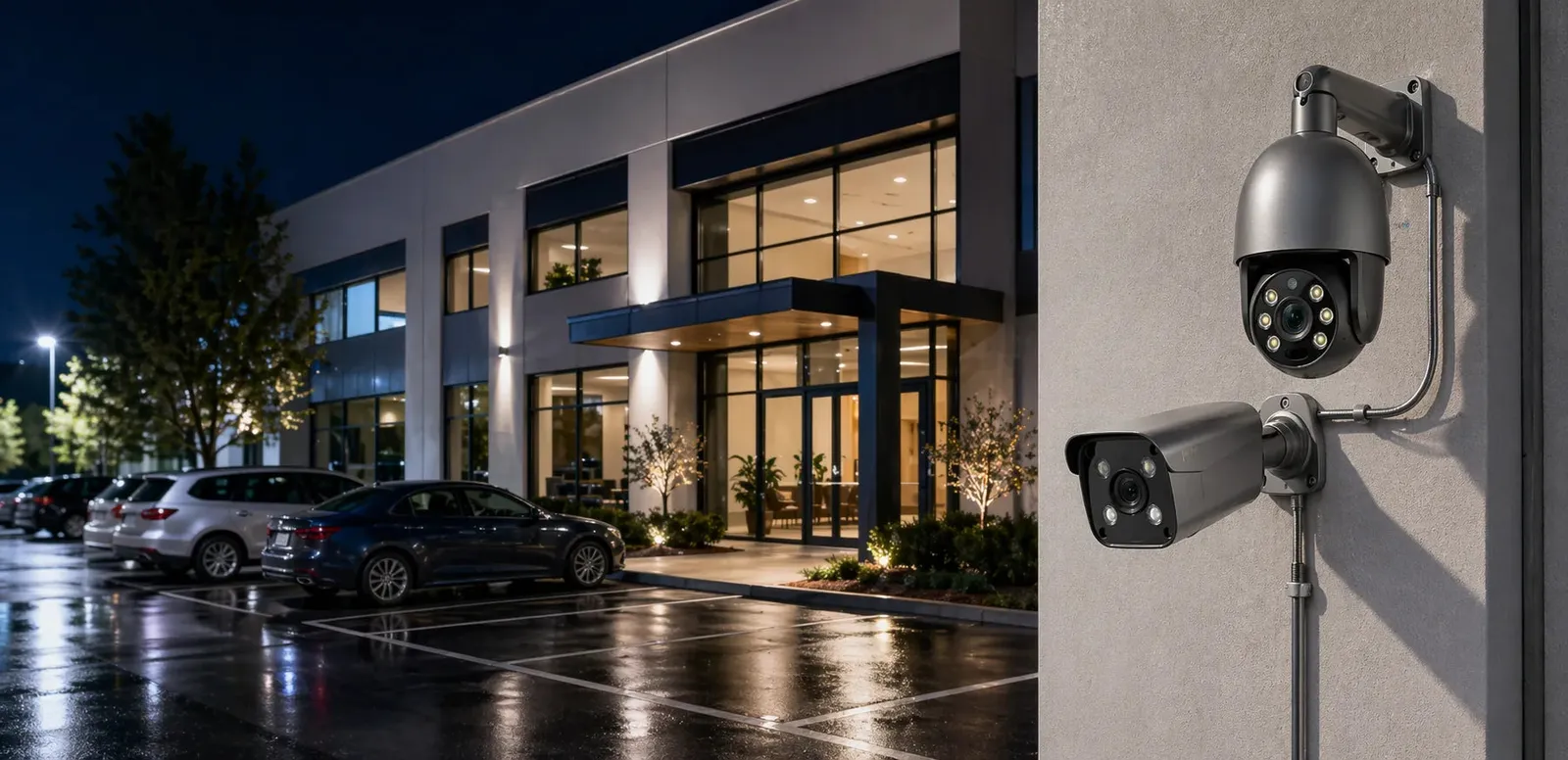
Night vision security cameras are used in home security camera systems, business surveillance system deployments, parking lots, warehouses, alleys, yards, driveways, and entrances. They may be fixed cameras, PTZ camera models, PoE camera models, or wireless cameras. Some record black-and-white images using infrared light. Others use full color night vision with visible light and sensitive sensors.
Night vision is not one feature. It is a mix of sensor sensitivity, lens design, exposure settings, infrared or visible light, mounting angle, and scene conditions.
Main Technical Explanation
Most traditional night vision cameras use infrared illumination. Infrared light is outside the visible range for humans but can be detected by camera sensors. The camera turns on IR LEDs when light falls below a threshold. The image usually switches to black and white because monochrome mode is more sensitive in low light and avoids color noise.
The camera includes an IR cut filter. During daytime, this filter helps block infrared light so colors look more natural. At night, the filter moves away from the sensor, allowing infrared light to reach it. This day-night switching is a core feature of many CCTV camera and IP camera designs.
Infrared distance ratings should be interpreted carefully. A camera may list an IR range such as 30 meters, 50 meters, or more, but real performance depends on scene reflectivity, lens angle, humidity, rain, fog, dust, and target size. A white wall reflects IR strongly, while dark clothing or open fields reflect less. A face at the edge of the IR range may not be clearly identifiable.
Low-light performance also depends on sensor size, aperture, shutter speed, gain, noise reduction, and image processing. Slower shutter speeds can make scenes brighter but may blur moving people or vehicles. Higher gain can brighten images but add noise. Noise reduction can smooth the image but remove fine detail. A good night vision camera balances brightness, motion clarity, and detail.
Some cameras use supplemental white light instead of or in addition to IR. White light allows color video at night, but it is visible and may affect neighbors, customers, wildlife, or site appearance. Full color night vision camera designs rely on visible light, sensitive sensors, wide apertures, and sometimes built-in warm lights.
Key Features or Concepts
IR illumination is convenient, but placement and beam angle matter. If the IR beam is narrower than the camera view, edges may be dark. If it is too strong near the camera, close objects may be overexposed.
Black-and-white and color night footage answer different questions. Infrared night vision usually produces black-and-white video. This is useful for shape, movement, and many identification tasks, but it cannot reliably show clothing color or vehicle color. Full color night vision can preserve color information if enough visible light is available.
Motion blur matters more than many sample images suggest. A bright still image is not enough. Security footage must capture moving people, vehicles, or animals. If the shutter speed is too slow, a person may appear as a blur. Buyers should evaluate moving night footage, not only still screenshots.
Night lighting changes constantly. Vehicle headlights, reflective license plates, wet pavement, and bright door lights can confuse exposure. Wide dynamic range and highlight control may help, but placement still matters.
The installation environment affects night footage directly. Rain, fog, snow, insects, spider webs, dust, and nearby walls can scatter or reflect IR light. Outdoor security camera placement should avoid close reflective surfaces in front of or beside the lens.
Buying Considerations
Start by deciding what detail is needed at night. If the goal is to know that someone entered a yard, basic IR night vision may be enough. If the goal is to identify faces or vehicle details, stronger lighting, better lens selection, and closer camera placement may be required.
Consider whether color is necessary. For many security tasks, black-and-white IR footage is acceptable. For incidents where clothing color, vehicle color, package color, or scene context matters, full color night vision may help. Color night vision may need visible light, which can be intrusive.
Check real low-light examples. Specification sheets are useful, but they do not fully describe performance. Buyers should look for sample footage from similar environments: parking lots, residential driveways, warehouses, or dark alleys. The most relevant test is the actual installation site after dark.
Plan supplemental lighting. A modest porch light, low-glare wall light, or separate IR illuminator can improve video dramatically. Lighting should be placed to illuminate the subject, not shine directly into the camera lens. In business surveillance system projects, lighting design and camera design should be planned together.
On larger sites, test one camera before mounting the full batch. A short night trial can reveal glare from signs, IR bounce from walls, motion blur near doors, or weak coverage at the edge of the scene. It is much cheaper to adjust one pilot location than to remount ten cameras after the NVR is already full of disappointing night footage.
Evaluate storage impact. Night scenes with noise, rain, insects, or moving tree shadows can increase bitrate. A night vision camera may use more storage at night than expected if compression has to encode noise and motion. NVR storage planning should account for this.
For PoE security camera system designs, verify power draw when IR LEDs turn on. Some cameras draw more power at night. Long-range IR or heater-equipped cameras may need PoE+ or a larger power budget.
Common Applications
Homeowners use night vision cameras for front doors, garages, yards, driveways, side gates, and patios. A home security camera that records clearly after dark can help review visitors, package deliveries, trespassing, and vehicle activity.
Small businesses use night vision cameras at storefronts, back doors, parking areas, loading docks, cash handling zones, and stock rooms. After-hours recording is often a core reason for installing a surveillance system.
Warehouses and industrial sites use night vision for perimeter fences, gates, yards, equipment storage, and low-light interior zones. PTZ camera models with long-range IR can help operators inspect large areas, though fixed cameras should maintain continuous coverage.
Rural properties, farms, and construction sites often need night vision because lighting may be limited. In these cases, power availability, camera mounting, and supplemental illumination are especially important.
Common Problems
One common problem is overexposure from nearby objects. A wall, soffit, post, or sign close to the camera can reflect IR and make the rest of the scene dark. Moving the camera or changing the angle can solve this.
Another problem is insects and spider webs. IR light attracts insects, and webs near the lens can glow brightly. Regular cleaning and strategic mounting reduce false motion alerts.
Night images may look bright but lack detail. Excessive noise reduction can make faces look smooth or smeared. Too much compression can create blocky artifacts. Buyers should evaluate detail, not just brightness.
License plates are difficult at night. Reflective plates and headlights can overexpose the image. Dedicated license plate recognition cameras, controlled angles, and special exposure settings may be needed.
Buyers may also assume IR light passes through glass. In many cases, IR reflects from windows and ruins the image. A camera placed behind glass is usually poor for night vision unless IR is disabled and external lighting is used.
FAQ
Do night vision cameras work in total darkness?
Infrared night vision cameras can work in darkness within their IR range. Full color night vision cameras usually need some visible light or built-in white light.
Why is night vision usually black and white?
Black-and-white mode is more sensitive in low light and works well with infrared illumination.
What IR distance do I need?
Choose based on the actual target distance, not the total property size. Remember that listed IR range is an estimate and may not guarantee identification at that distance.
Why does my camera look foggy at night?
Common causes include dirty lens cover, dome reflection, water spots, spider webs, fog, or IR reflecting from nearby surfaces.
Is full color night vision better than infrared?
It is better when color detail is important and visible light is acceptable. Infrared is better when discreet black-and-white recording is enough.
How QuarkView Can Help
Night performance is easier to judge when this guide is read with full color night vision guide, 4MP, 5MP, and 8MP comparison, outdoor installation guide, and IP camera buying guide because lighting, resolution, placement, and camera selection all interact after dark.
When reviewing QuarkView options, look at AI camera systems, single PoE cameras, and PoE camera systems to match low-light expectations with camera intelligence, wired reliability, and the number of views required.
QuarkView note: QuarkView recommends testing night footage at the real site where possible and matching IR, full-color, or supplemental lighting to the type of evidence the buyer needs.
Summary
Night vision security cameras use infrared illumination, sensitive sensors, image processing, or visible light to record in low-light conditions. Good night performance depends on lighting, lens, sensor, shutter speed, mounting, weather, storage, and power planning. Buyers should test footage at the real site after dark and choose between infrared and full color night vision based on the evidence they need.
Reference Sources
- ITU-T H.264 and ITU-T H.265 for codec context affecting storage and quality.
- IEC 60529 overview from IEC for outdoor ingress protection context.
- NIST IR 8259A for connected camera cybersecurity capabilities.
- CISA IoT Security for secure deployment practices.
- ONVIF Profiles for IP camera interoperability.