
QuarkView Security Learning Center. This guide is part of QuarkView's practical security camera knowledge base for buyers, installers, and project teams planning connected surveillance systems.
Use it to connect GDPR video surveillance concepts, purpose limitation, signage, retention, access control, and buyer review with practical procurement, installation, support, and long-term operation decisions.
QuarkView Security Learning Center | IP Camera Cybersecurity, Responsible CCTV, and Smart Surveillance Knowledge Base
GDPR and Video Surveillance: Basic Concepts for International Buyers explains GDPR video surveillance as a practical operating discipline for modern surveillance, not a one-time product setting. It focuses on the basic privacy concepts international buyers should understand before deploying cameras in or around European contexts. The topic sits at the intersection of cybersecurity, privacy, compliance awareness, responsible surveillance, and future-ready system design.
Within the QuarkView cybersecurity knowledge base, the goal is to make surveillance technology easier to evaluate without turning the article into legal advice or a sales pitch. Security buyers should use these ideas to ask better questions, document decisions, and coordinate with qualified IT, privacy, or legal professionals when the risk profile requires it.
The same principles apply whether the organization operates a single CCTV camera, a mixed IP camera fleet, a PoE security camera system, an NVR security system, remote viewing for supervisors, AI surveillance analytics, an edge AI security camera, a smart video surveillance platform, or a broader business surveillance system.
How it works
GDPR video surveillance discussions begin with a caution: this article is educational and is not legal advice. Buyers, installers, and business owners should consult qualified counsel or a privacy professional for jurisdiction-specific decisions. That said, the core concepts are useful for international buyers because they encourage disciplined thinking about purpose, necessity, transparency, security, retention, and individual rights.
The GDPR applies to personal data, and video footage can be personal data when people are identifiable directly or indirectly. A business camera that records customers, employees, contractors, neighbors, license plates, or visitors may therefore create data protection obligations. The important practical question is not whether a camera is called a security device; it is whether identifiable people are recorded and how that recording is used.
A lawful basis is needed for processing. In many business surveillance scenarios, organizations consider legitimate interests, but that basis is not automatic. The organization should identify the purpose, assess whether video is necessary and proportionate, consider impacts on individuals, and avoid excessive monitoring. More intrusive uses, sensitive locations, audio capture, employee monitoring, biometric identification, or analytics may require additional analysis and safeguards.
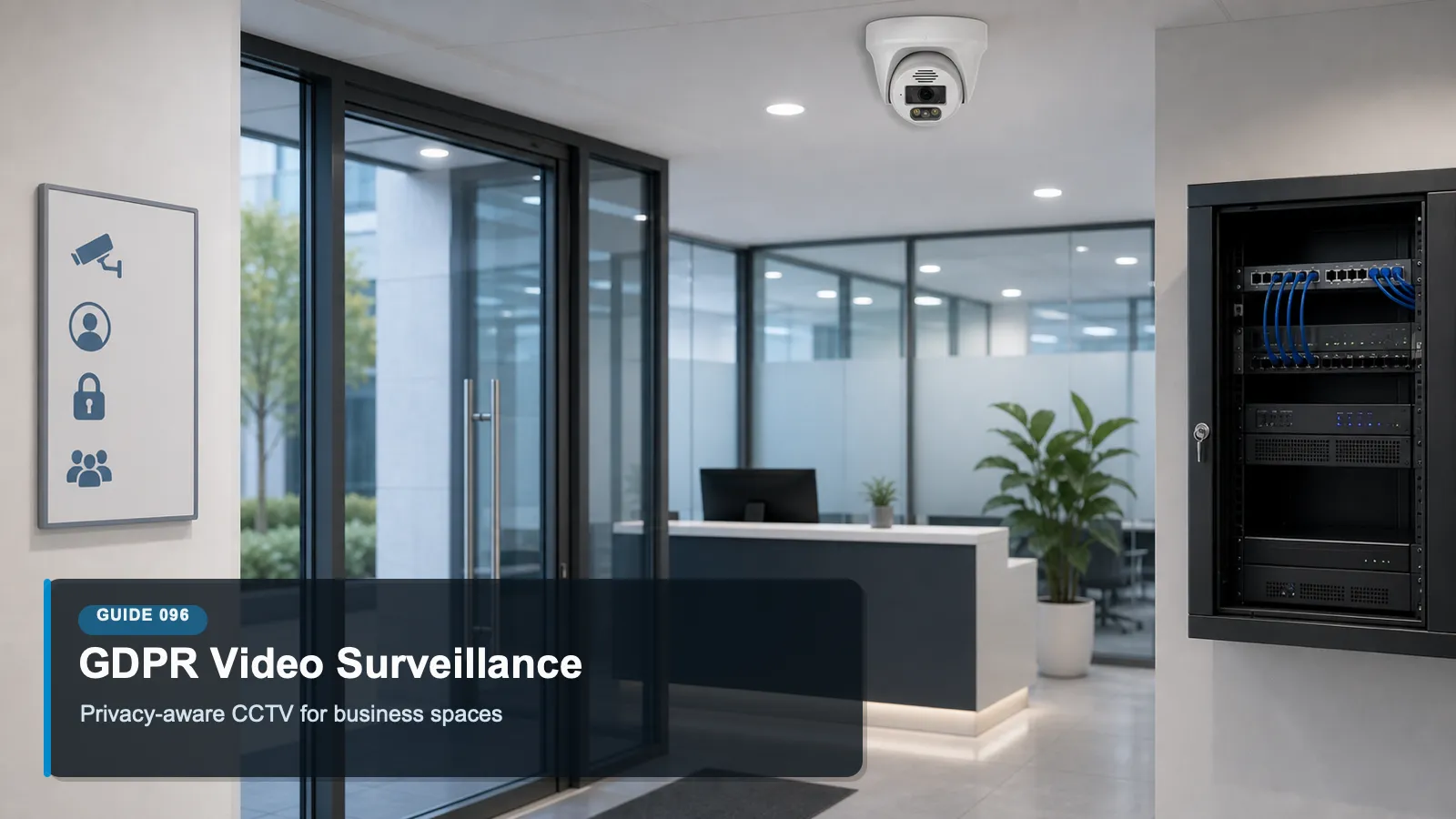
Transparency is also central. People should generally be informed that video surveillance is taking place, who is responsible, why footage is collected, how long it is retained, and how they can exercise rights. Notices should be clear and visible, not hidden in a policy nobody can find. International buyers should remember that privacy expectations and local implementations vary, so signage and policy content should be reviewed for the specific country and use case.
Features to compare
Personal data: Footage can be personal data when a person is identifiable, even if the system is used primarily for safety or asset protection.
Lawful basis: The organization needs an appropriate legal basis for processing and should document why it applies to the surveillance purpose.
Necessity and proportionality: Camera placement, field of view, retention, audio, and analytics should be limited to what is needed for the stated purpose.
Transparency: Visible notices and accessible information help individuals understand who operates the system and why.
Rights handling: Organizations may need a process for access requests, deletion requests, objections, and other data subject rights where applicable.
Security of processing: Access controls, encryption, logging, retention, and incident response support the duty to protect video data.
A useful way to apply these concepts is to write them into the commissioning checklist. When a new camera, recorder, switch, mobile app, or analytics feature is added, the team should ask how that change affects inventory, accounts, network exposure, data protection, and ongoing maintenance.
Set access and footage handling requirements
Ask whether the system supports retention limits, role-based access, logs, export controls, and selective camera permissions.
Check whether notices, privacy information, and camera purpose records can be maintained for each site.
Evaluate whether analytics or biometric functions can be disabled, scoped, or separately governed.
Consider data location, cloud processing, support access, and cross-border transfer questions before procurement.
Confirm that the buyer, installer, and service provider understand their respective responsibilities and documentation needs.
Common Applications
GDPR video surveillance applies differently across environments, but the same governance pattern repeats: define the purpose, limit access, protect the network path, manage stored footage, and review the system as business needs change.
A European retail site using cameras for theft prevention while limiting views into staff-only areas.
An international company applying GDPR-inspired controls across global offices for consistency.
A logistics warehouse documenting retention and access rules for dock and perimeter cameras.
A hotel or apartment operator using signage, access roles, and short retention for shared spaces.
A buyer comparing cloud and local NVR options with attention to where data is stored and who can access it.
Common Problems
Most surveillance problems do not come from one dramatic failure. They come from small gaps that compound over time: devices outside the inventory, shared accounts, unpatched firmware, unclear ownership, unmanaged exports, and settings that remain unchanged after the site layout or staffing model changes.
Cameras are installed before the organization defines purpose, lawful basis, retention, or notice language.
Camera views capture areas that are not necessary for security, such as neighboring property or private workspaces.
Footage is kept indefinitely because storage is cheap or retention was never configured.
Too many staff members have access to playback or export, weakening accountability.
AI analytics or biometric features are enabled without a separate privacy, fairness, and necessity review.
The best response is a calm review process. Identify the device or workflow, document the risk, decide whether configuration, training, network controls, vendor support, or replacement is the right fix, and then verify that the change actually worked.
FAQ
Q: Does GDPR ban CCTV?
A: No. GDPR does not ban video surveillance, but it requires an appropriate basis, transparency, proportionate use, security, retention controls, and rights handling where applicable.
Q: Is signage enough for compliance?
A: Signage is important, but it is not the entire program. Organizations also need purpose documentation, access control, retention settings, security measures, and a rights-handling process.
Q: Can businesses record employees?
A: Employee monitoring can be sensitive and may be subject to labor, privacy, and local rules. Businesses should assess necessity, proportionality, transparency, and local legal requirements before recording work areas.
Q: Does GDPR apply outside the European Union?
A: It can apply in some non-EU contexts, depending on establishment, offering goods or services, monitoring behavior, and other factors. International buyers should seek jurisdiction-specific advice.
Q: Are license plates personal data?
A: They may be personal data when they can identify or be linked to an individual. Automatic license plate recognition can raise additional risk because it creates searchable movement records.
Q: What should buyers ask suppliers?
A: Ask about access roles, logs, retention, deletion, export controls, cloud location, support access, security updates, and whether analytics can be disabled or narrowly configured.
Summary
GDPR video surveillance is best approached through disciplined questions: why is the camera needed, what is captured, who can access it, how long is it kept, how are people informed, and how is footage protected? International buyers should not treat this as a legal checklist copied between countries. They should use the concepts to design proportionate systems and then verify local obligations with qualified advice.
For practical implementation, start with the controls that are easiest to verify: inventory, unique accounts, secure remote access, firmware review, retention settings, export discipline, and periodic access review. These basics create a foundation for more advanced analytics, cloud workflows, and future system expansion.
A useful review habit is to assign one owner for the camera environment, one owner for network and identity controls, and one owner for footage handling. Even in a small business, naming responsibilities prevents security, privacy, and maintenance tasks from becoming assumptions that nobody verifies.
For larger deployments, the same idea can be expanded into a quarterly checklist that records device changes, account changes, firmware status, retention exceptions, export requests, remote access reviews, and unresolved risks.
Plan Your Security Camera Project With QuarkView
QuarkView helps buyers review GDPR video surveillance concepts, purpose limitation, signage, retention, access control, and buyer review before choosing cameras, NVRs, PoE infrastructure, remote access methods, and support workflows.
Explore QuarkView security camera systems or contact QuarkView for project and volume inquiry support.
Related QuarkView Planning Resources
For the next planning step, compare Default Password Risks in CCTV Systems and How to Prevent Them, CCTV Product Certification Basics for International Buyers, 4G LTE Security Cameras Explained for Remote Surveillance, Audio Recording in CCTV Systems: Uses, Limits, and Buyer Notes, Battery Security Cameras vs PoE Cameras: Practical Comparison. These related guides connect product selection, placement, recording, installation, and long-term reliability decisions.
Related QuarkView Collections
Reference Sources
Regulation (EU) 2016/679, General Data Protection Regulation. https://eur-lex.europa.eu/eli/reg/2016/679/oj
EDPB Guidelines 3/2019 on processing personal data through video devices. https://www.edpb.europa.eu/our-work-tools/our-documents/guidelines/guidelines-32019-processing-personal-data-through-video_en
UK Information Commissioner's Office, CCTV and video surveillance guidance. https://ico.org.uk/for-organisations/uk-gdpr-guidance-and-resources/cctv-and-video-surveillance/
NIST Privacy Framework. https://www.nist.gov/privacy-framework
NIST Cybersecurity Framework 2.0. https://www.nist.gov/cyberframework
Regulation (EU) 2024/1689, Artificial Intelligence Act. https://eur-lex.europa.eu/eli/reg/2024/1689/oj/eng