
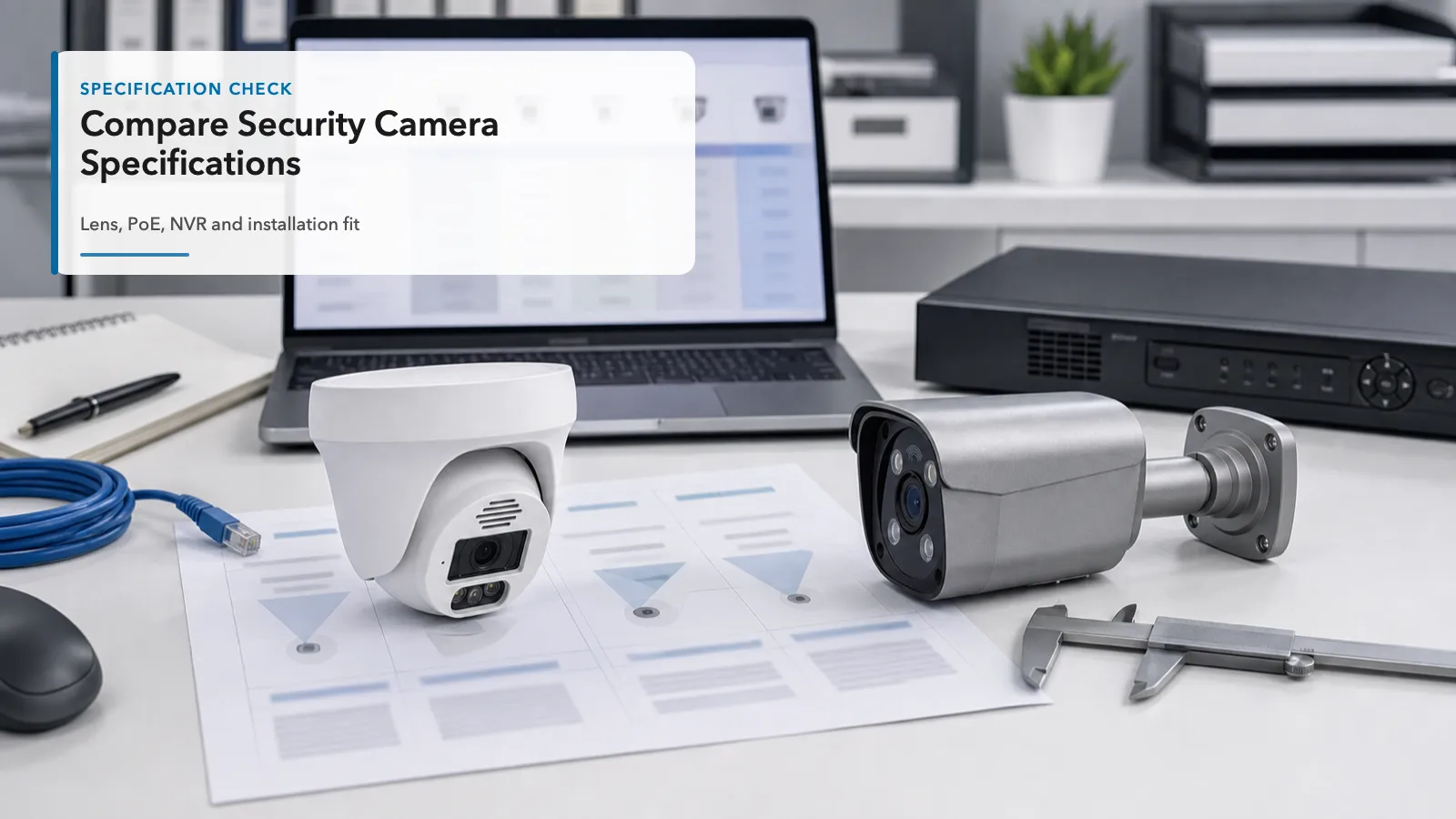
QuarkView Security Learning Center. This buyer guide is written for importers, distributors, installers, and project teams comparing real surveillance products, not only catalog claims.
Use it to connect security camera specifications, lens angle, PoE, NVR compatibility, storage, and outdoor installation fit with practical procurement, installation, support, and reorder decisions.
In international security projects, security camera specifications decisions are rarely about a single datasheet. Importers, distributors, installers, and project buyers need to know whether the claimed camera performance, recorder capacity, firmware behavior, packaging method, export documentation, and after-sales communication will remain consistent after the sample stage. This QuarkView CCTV buyer guide explains reading datasheets in a way that connects technical claims to installation results and project risk in practical procurement language for B2B buyers.
The same evaluation logic applies whether the immediate purchase is an security camera specifications, an IP camera for a pilot site, a PoE camera for a wired retrofit, a PoE security camera system for a chain store, an NVR security system for centralized recording, an outdoor security camera for perimeter coverage, a business surveillance system for operations, or wholesale security camera kits supplied by a CCTV camera manufacturer or security camera supplier.
The purpose is to help buyers compare supplier evidence, product claims, and project conditions before committing to bulk production. International B2B platforms such as Alibaba International Station make it easy to find many offers, but the buyer still needs a disciplined review method that connects specification sheets with installation reality, local compliance, and support needs.
How it works
Security camera specifications can look precise while still hiding important tradeoffs. Resolution, compression, lens size, sensor size, minimum illumination, WDR, IR distance, frame rate, bitrate, PoE class, IP rating, and operating temperature are all useful, but they should be interpreted as a system. A 4 MP camera with a suitable lens and stable low-light processing may serve a doorway better than a higher-resolution model with a narrow dynamic range or poor night image control.
Buyers should compare optical and imaging information before comparing software features. Sensor size, lens focal length, field of view, aperture, IR design, WDR method, shutter control, and mounting height determine whether the camera captures useful evidence. Datasheets that show only megapixels and IR distance are incomplete for serious project review because they do not explain face coverage, plate visibility, glare behavior, or scene width.
Network and recording specifications also need careful reading. H.264 and H.265 support, substream settings, bitrate control, ONVIF profile, RTSP support, event output, audio support, storage options, and firmware update method influence NVR compatibility. For a PoE camera or NVR security system, buyers should check not only camera channels but also incoming bandwidth, decoding capacity, disk bay count, RAID support if needed, and remote viewing limitations.
Environmental and compliance specifications should be interpreted against the installation site. An outdoor security camera near a loading dock, seaside property, freezer entrance, or industrial yard has different exposure than a lobby camera. Ingress rating, enclosure material, cable gland design, corrosion resistance, surge protection, temperature range, and installation manual details can decide whether a camera remains serviceable after the first season.
A useful technical review connects the camera layer, recorder layer, network layer, application layer, packaging layer, and service layer. If one of these layers is weak, the buyer may receive hardware that appears attractive in a quotation but creates avoidable field cost. Procurement teams should therefore combine datasheet review, sample testing, supplier questioning, and document checks instead of treating any single source of information as complete.
Traceability is also part of technical control. Buyers should keep a folder for approved quotations, sample photos, firmware screenshots, test videos, label proofs, packing lists, conformity documents, and supplier corrections. This record gives the purchasing team a practical reference when production questions arise, and it helps after-sales staff explain whether a reported issue is a product fault, installation condition, configuration choice, or documentation gap.
Features to compare
The following concepts give buyers a practical vocabulary for comparing offers. They can be adapted into a request-for-quotation sheet, sample-test report, supplier audit form, or internal approval memo.
Resolution: Treat resolution as one factor, not the complete measure of image value. Scene coverage, lens choice, compression, light level, and mounting position are equally important.
Lens and field of view: A wider lens covers more area but reduces pixel density on a face or object. A narrower lens may be required for gates, counters, and vehicle lanes.
Compression and bitrate: H.265 can reduce storage demand, but actual savings depend on scene motion, firmware quality, NVR support, and the buyer's retention target.
PoE and power: Confirm IEEE PoE support, power draw with IR on, heater or motorized lens demand, and switch budget across all channels.
Interoperability: ONVIF claims should be verified by profile, firmware version, and required feature, not accepted as a single yes-or-no label.
Match equipment to the site requirements
A QuarkView-style supplier evaluation checklist should convert every important claim into evidence. For example, a claim about compatibility should lead to profile details and a test result; a claim about weather resistance should lead to enclosure evidence and installation guidance; a claim about warranty should lead to a written process, not only a sales message.
The buyer should also assign ownership inside the purchasing team. One person can review commercial terms, another can check technical evidence, and another can confirm packaging, labeling, and import documents. This prevents a common sourcing gap where every participant assumes another person has checked the details. A short approval record with dates, sample identifiers, supplier answers, and open questions is often enough to make later decisions more orderly.
Create a requirements sheet before reading catalogs. List scene type, mounting height, target object, lighting condition, recording days, remote access need, and local compliance requirements.
Ask suppliers to provide real image samples from similar scenes instead of only studio images. A showroom image does not predict backlight or rain behavior.
Calculate storage with the chosen resolution, frame rate, codec, bitrate, number of channels, recording mode, and retention period. A low camera price may be offset by larger hard-disk needs.
Compare product manuals and firmware screenshots. A complete manual often reveals configuration limits that a short datasheet omits.
Check accessory compatibility: junction boxes, wall mounts, pole mounts, power supplies, PoE switches, hard disks, and surge protection can change the final system cost.
Common Applications
The decision model can be used in several channel and project environments. The buyer should adjust the depth of review according to order value, customer risk, installation complexity, and local legal responsibilities.
Retail stores comparing dome cameras for entrances, aisles, stock rooms, point-of-sale areas, and delivery doors.
Warehouses planning a PoE security camera system where long cable runs, forklift movement, and low-light zones affect camera selection.
Residential and small business distributors building catalog tiers for wholesale security camera kits.
Project integrators reviewing a CCTV camera manufacturer offer against tender specifications and local installation standards.
Common Problems
Common problems usually come from unclear requirements, incomplete evidence, or assumptions that are not tested before production. The following issues should be reviewed before deposit, inspection, or shipment release.
Megapixel-only comparison: Add lens, field of view, bitrate, low-light method, and storage impact to the comparison.
Unclear IR distance: Ask how the distance was measured and test real scenes with reflective and dark objects.
Hidden NVR limits: Check incoming bandwidth, playback channels, decoding capacity, and mobile-viewing limits.
Overlooked PoE budget: Calculate maximum power draw when IR, motorized lens, heater, or audio functions are active.
Certification label confusion: Confirm that model names and power supplies match the conformity documents for the target market.
FAQ
What is the first specification to compare?
Start with the scene requirement. After that, lens, field of view, resolution, WDR, low-light behavior, and mounting position can be evaluated together.
Is H.265 always preferable?
It is useful when supported across camera, recorder, and playback devices, but compatibility and actual scene behavior should be tested.
How should buyers verify IP rating?
Request the rating basis, enclosure photos, cable entry design, and test evidence. Installation quality also affects weather resistance.
Why do two cameras with the same resolution look different?
Sensor, lens, firmware processing, WDR method, shutter behavior, compression, and lighting all affect the final image.
Should buyers demand every feature in one model?
No. A focused model that fits the site is often more reliable than an overloaded feature list that adds cost and configuration complexity.
Summary
For security camera specifications, a balanced decision considers technical fitness, supplier discipline, documentation, service process, and the buyer's own channel requirements. A lower unit price is useful only when the complete system can be installed, supported, reordered, and explained to customers with confidence.
The final approval should therefore include both the first order and the reorder plan. Buyers should know how repeat orders will be checked, how obsolete models will be communicated, and how support teams will recognize differences between old and new batches. That lifecycle view is especially important for distributors and installers who must support installed systems long after the invoice has been paid.
As part of the QuarkView security camera knowledge base, this article treats procurement as a repeatable risk-control process. Buyers who document requirements, test samples carefully, verify claims, and plan after-sales handling are better prepared to build reliable CCTV sourcing programs without relying on aggressive promotional language.
Plan Your Security Camera Project With QuarkView
QuarkView helps international buyers review security camera specifications, lens angle, PoE, NVR compatibility, storage, and outdoor installation fit before committing to samples, bulk production, private-label packaging, or CCTV kit distribution.
Explore QuarkView security camera systems or contact QuarkView for project and volume inquiry support.
Related QuarkView Planning Resources
For the next planning step, compare How to Evaluate NVR and Camera Kit Quality Before Bulk Purchase, Common Mistakes When Buying CCTV Systems from Overseas Suppliers, How to Choose Security Camera Kits for Retail or Distribution, Security Camera Sample Testing Checklist for Importers, CCTV Product Certification Basics for International Buyers. These related guides connect product selection, placement, recording, installation, and long-term reliability decisions.
Related QuarkView Collections
Reference Sources
The following public sources were used as background references for standards, conformance, compliance, and cybersecurity concepts relevant to international surveillance procurement.
ONVIF Profile T for advanced video streaming. https://www.onvif.org/profiles/profile-t/
ONVIF Profile S for basic video streaming. https://www.onvif.org/profiles/profile-s/
ONVIF conformant products database and conformance guidance. https://www.onvif.org/conformant-products/
IEEE 802.3bt-2018 Power over Ethernet over four pairs. https://standards.ieee.org/standard/802_3bt-2018/
Intertek overview of ingress protection testing under IEC 60529. https://www.intertek.com/lighting/performance/ingress-protection/
NIST IR 8259A IoT Device Cybersecurity Capability Core Baseline. https://csrc.nist.gov/pubs/ir/8259/a/final