
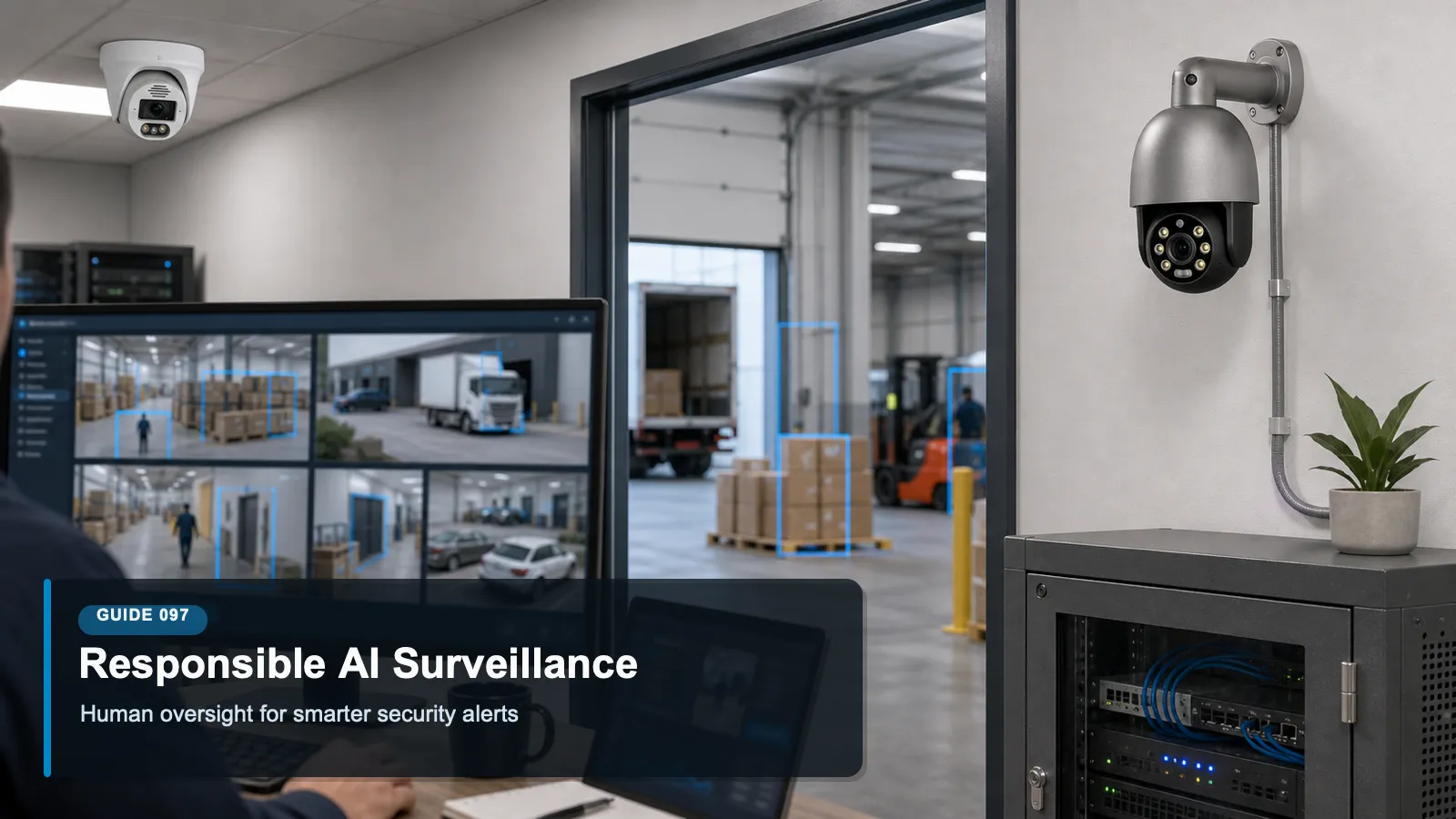
QuarkView Security Learning Center. This guide is part of QuarkView's practical security camera knowledge base for buyers, installers, and project teams planning connected surveillance systems.
Use it to connect responsible AI surveillance, analytics governance, alert review, data minimization, and business camera policy with practical procurement, installation, support, and long-term operation decisions.
QuarkView Security Learning Center | IP Camera Cybersecurity, Responsible CCTV, and Smart Surveillance Knowledge Base
Responsible Use of AI Security Cameras in Business Environments explains responsible AI surveillance as a practical operating discipline for modern surveillance, not a one-time product setting. It focuses on the governance of video analytics, object detection, face-related features, anomaly alerts, people counting, and automated event workflows. The topic sits at the intersection of cybersecurity, privacy, compliance awareness, responsible surveillance, and future-ready system design.
Within the QuarkView cybersecurity knowledge base, the goal is to make surveillance technology easier to evaluate without turning the article into legal advice or a sales pitch. Security buyers should use these ideas to ask better questions, document decisions, and coordinate with qualified IT, privacy, or legal professionals when the risk profile requires it.
The same principles apply whether the organization operates a single CCTV camera, a mixed IP camera fleet, a PoE security camera system, an NVR security system, remote viewing for supervisors, AI surveillance analytics, an edge AI security camera, a smart video surveillance platform, or a broader business surveillance system.
How it works
Responsible AI surveillance means using camera analytics to support human decision making without pretending that every alert is objective truth. AI security cameras can identify motion patterns, vehicles, packages, line crossing, crowding, hard hats, perimeter events, or other visual signals. These features can improve efficiency, but they can also create false positives, missed detections, biased outcomes, or intrusive monitoring if deployed without purpose and oversight.
The first responsible-use question is purpose. A business should identify the specific risk or workflow the analytic supports. A loading dock may need vehicle detection for safety. A retail entrance may need people counting for occupancy trends. A restricted area may need line-crossing alerts after hours. The same technology becomes more sensitive when used to track employees, classify behavior, identify individuals, or make decisions about discipline or access.
The second question is performance. Camera analytics are affected by lighting, angle, distance, weather, occlusion, uniforms, reflections, bandwidth, compression, and scene changes. A model that performs acceptably in a bright lobby may fail in a warehouse aisle or parking lot at night. Responsible deployment includes testing in the real environment, documenting limitations, reviewing false alerts, and adjusting camera placement or thresholds before relying on the result.
The third question is governance. AI alerts should have clear response procedures, human review for consequential actions, retention limits for analytics metadata, and access controls for dashboards. Staff should understand that an alert is a signal requiring judgment, not proof by itself. When analytics involve sensitive features such as face recognition or biometric identification, organizations should apply a much higher review standard and verify applicable legal requirements.
Features to compare
Purpose definition: Write down what problem the analytic is intended to solve and which cameras, times, and locations are in scope.
Human oversight: Require human review before taking consequential actions based on AI alerts, especially where people may be affected.
Performance testing: Test analytics in the actual environment and track false positives, false negatives, and scene conditions that reduce reliability.
Data minimization: Collect only the metadata needed for the purpose, and avoid indefinite retention of searchable event histories.
Transparency: Use clear internal policies and appropriate external notices when analytics materially change how surveillance operates.
Change management: Re-test analytics after camera repositioning, firmware updates, model changes, lighting changes, or business layout changes.
A useful way to apply these concepts is to write them into the commissioning checklist. When a new camera, recorder, switch, mobile app, or analytics feature is added, the team should ask how that change affects inventory, accounts, network exposure, data protection, and ongoing maintenance.
Set access and footage handling requirements
Ask vendors how analytics are trained, configured, tested, updated, and documented for limitations.
Check whether analytics can be enabled only on selected cameras, schedules, zones, and event types.
Evaluate whether the system logs alert handling, user access, model updates, and export of analytics data.
Confirm whether sensitive features such as face recognition are optional, disabled by default, and governed separately.
Look for clear ways to review false alerts, adjust thresholds, and disable features that are not necessary.
Common Applications
responsible AI surveillance applies differently across environments, but the same governance pattern repeats: define the purpose, limit access, protect the network path, manage stored footage, and review the system as business needs change.
Retail occupancy trends where aggregate people counts are useful and individual identification is unnecessary.
Warehouse safety alerts for vehicles, blocked exits, or restricted zones where human review follows each alert.
Office perimeter monitoring outside business hours with schedules that avoid unnecessary employee monitoring.
Construction site safety observations, such as helmet or restricted-zone alerts, with documented limitations.
Multi-site businesses comparing alert rates to improve camera placement and reduce operator fatigue.
Common Problems
Most surveillance problems do not come from one dramatic failure. They come from small gaps that compound over time: devices outside the inventory, shared accounts, unpatched firmware, unclear ownership, unmanaged exports, and settings that remain unchanged after the site layout or staffing model changes.
AI alerts are treated as proof even when lighting, occlusion, or angle makes the detection unreliable.
Analytics are enabled everywhere because the feature exists, not because each use has a defined purpose.
False alerts overwhelm operators, causing them to ignore genuinely important events.
Metadata is retained longer than video, creating a searchable activity history that was never reviewed for privacy risk.
Sensitive identification features are enabled without legal, ethical, operational, and security review.
The best response is a calm review process. Identify the device or workflow, document the risk, decide whether configuration, training, network controls, vendor support, or replacement is the right fix, and then verify that the change actually worked.
FAQ
Q: Does responsible AI surveillance mean avoiding AI cameras?
A: No. It means using analytics with a defined purpose, proportionate scope, tested performance, human oversight, and clear data handling rules.
Q: Are AI camera alerts reliable enough for security decisions?
A: They can support decisions, but reliability depends on the environment and configuration. Consequential actions should include human review and awareness of false positives and false negatives.
Q: Is people counting less sensitive than face recognition?
A: Usually, aggregate people counting is less intrusive than identifying individuals, but it still deserves purpose, retention, access, and transparency controls.
Q: How often should AI analytics be re-tested?
A: Re-test after installation, after major scene changes, after firmware or model updates, and periodically as lighting, layouts, uniforms, or traffic patterns change.
Q: Who should own AI camera governance?
A: Security, IT, privacy, legal, HR, operations, and site management may all have roles. The owner should be clear enough that settings and incidents do not drift unmanaged.
Q: What is a practical first step?
A: Choose one analytic, define the purpose, test it in the real scene, record limitations, assign response steps, and review whether the benefit justifies the data collected.
Summary
Responsible AI surveillance is a governance practice. It asks whether the analytic is necessary, whether it works in the real scene, whether people understand its limits, whether access and retention are controlled, and whether humans remain accountable for decisions. Used carefully, analytics can reduce workload and improve response. Used casually, they can create privacy, fairness, and operational problems.
For practical implementation, start with the controls that are easiest to verify: inventory, unique accounts, secure remote access, firmware review, retention settings, export discipline, and periodic access review. These basics create a foundation for more advanced analytics, cloud workflows, and future system expansion.
A useful review habit is to assign one owner for the camera environment, one owner for network and identity controls, and one owner for footage handling. Even in a small business, naming responsibilities prevents security, privacy, and maintenance tasks from becoming assumptions that nobody verifies.
For larger deployments, the same idea can be expanded into a quarterly checklist that records device changes, account changes, firmware status, retention exceptions, export requests, remote access reviews, and unresolved risks.
Plan Your Security Camera Project With QuarkView
QuarkView helps buyers review responsible AI surveillance, analytics governance, alert review, data minimization, and business camera policy before choosing cameras, NVRs, PoE infrastructure, remote access methods, and support workflows.
Explore QuarkView security camera systems or contact QuarkView for project and volume inquiry support.
Related QuarkView Planning Resources
For the next planning step, compare The Future of Smart Video Surveillance for Homes and Businesses, Data Protection Basics for Business Surveillance Systems, How to Choose a 4K Security Camera System: A Buyer's Guide, Complete Surveillance System Guide for Homes and Businesses, IP Camera Buying Guide for Home and Business Security. These related guides connect product selection, placement, recording, installation, and long-term reliability decisions.
Related QuarkView Collections
Reference Sources
NIST Artificial Intelligence Risk Management Framework. https://www.nist.gov/itl/ai-risk-management-framework
Regulation (EU) 2024/1689, Artificial Intelligence Act. https://eur-lex.europa.eu/eli/reg/2024/1689/oj/eng
NIST Privacy Framework. https://www.nist.gov/privacy-framework
EDPB Guidelines 3/2019 on processing personal data through video devices. https://www.edpb.europa.eu/our-work-tools/our-documents/guidelines/guidelines-32019-processing-personal-data-through-video_en
ONVIF Profile M for metadata and analytics events. https://www.onvif.org/profiles/profile-m/
NIST Cybersecurity Framework 2.0. https://www.nist.gov/cyberframework