
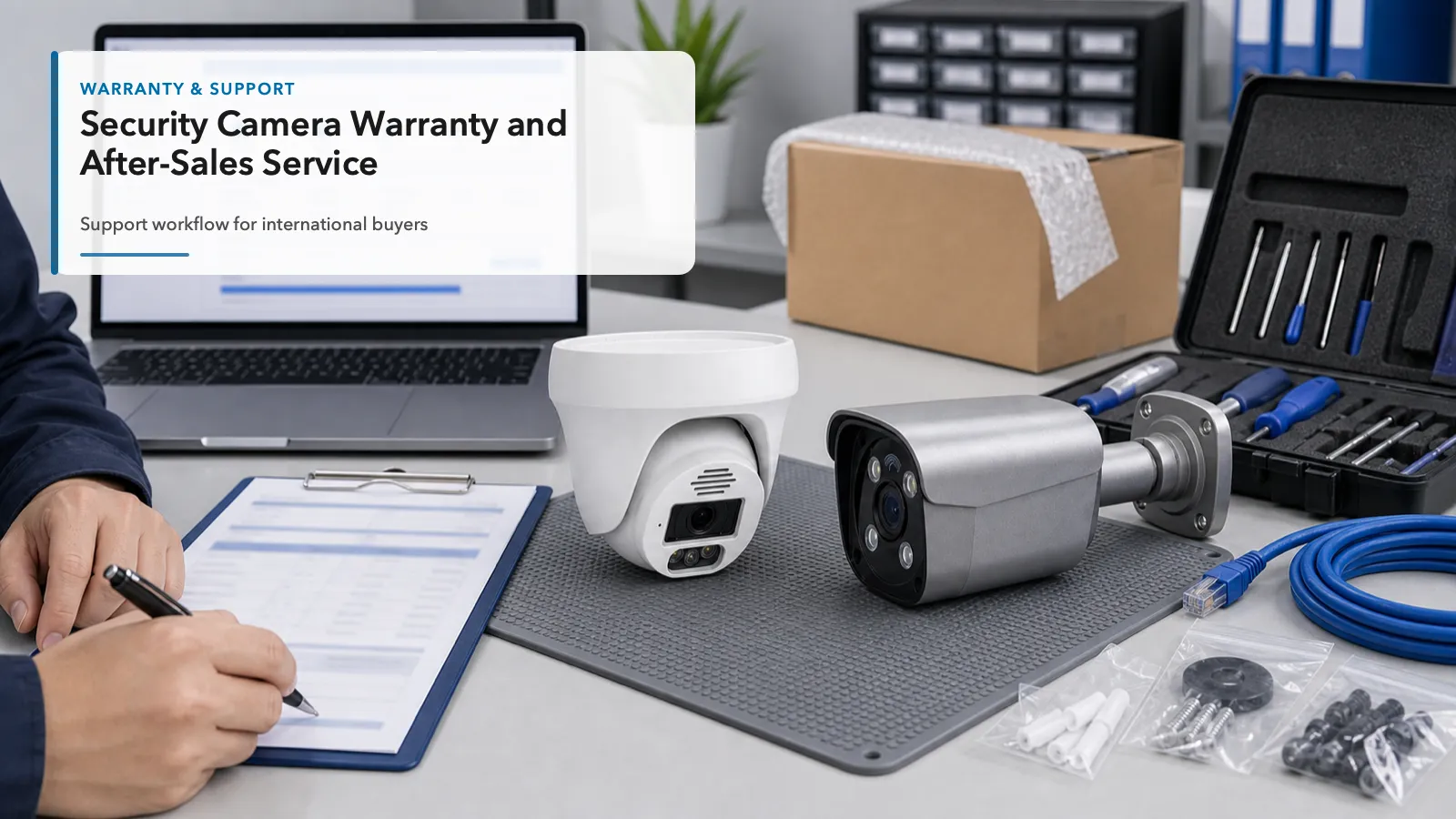
QuarkView Security Learning Center. This buyer guide is written for importers, distributors, installers, and project teams comparing real surveillance products, not only catalog claims.
Use it to connect security camera warranty, RMA handling, technical support, replacement parts, and after-sales workflow with practical procurement, installation, support, and reorder decisions.
In international security projects, security camera warranty decisions are rarely about a single datasheet. Importers, distributors, installers, and project buyers need to know whether the claimed camera performance, recorder capacity, firmware behavior, packaging method, export documentation, and after-sales communication will remain consistent after the sample stage. This QuarkView CCTV buyer guide explains evaluating warranty terms as a practical service system rather than a short marketing line in practical procurement language for B2B buyers.
The same evaluation logic applies whether the immediate purchase is an security camera warranty, an IP camera for a pilot site, a PoE camera for a wired retrofit, a PoE security camera system for a chain store, an NVR security system for centralized recording, an outdoor security camera for perimeter coverage, a business surveillance system for operations, or wholesale security camera kits supplied by a CCTV camera manufacturer or security camera supplier.
The purpose is to help buyers compare supplier evidence, product claims, and project conditions before committing to bulk production. International B2B platforms such as Alibaba International Station make it easy to find many offers, but the buyer still needs a disciplined review method that connects specification sheets with installation reality, local compliance, and support needs.
How it works
A security camera warranty is only useful when the buyer understands how it will be executed. The written term, such as one year or two years, is only the beginning. Importers and distributors need to know what defects are covered, what evidence is required, who pays freight, whether repair or replacement is offered, how firmware issues are handled, and how long the response process usually takes.
Warranty scope should separate hardware faults, installation damage, power surge, water ingress, firmware bugs, cloud service issues, hard-disk failures, and accessory problems. A supplier may cover camera hardware but exclude improper installation or third-party power damage. That can be reasonable, but the buyer should know these boundaries before selling the product line to installers or retail customers.
After-sales service also depends on documentation quality. Clear manuals, reset instructions, firmware release notes, troubleshooting guides, mobile app guides, NVR pairing instructions, and wiring diagrams reduce support tickets. A PoE security camera system with weak documentation can appear defective even when the hardware works because installers cannot activate, configure, or recover it efficiently.
The buyer should also evaluate service capacity. A supplier that answers pre-sale messages quickly may not have trained technical staff for post-sale fault analysis. Ask for RMA forms, defect classification rules, remote diagnostic process, firmware update policy, spare-parts availability, and contact escalation. This is especially important for a business surveillance system where downtime can affect safety, operations, and customer trust.
A useful technical review connects the camera layer, recorder layer, network layer, application layer, packaging layer, and service layer. If one of these layers is weak, the buyer may receive hardware that appears attractive in a quotation but creates avoidable field cost. Procurement teams should therefore combine datasheet review, sample testing, supplier questioning, and document checks instead of treating any single source of information as complete.
Traceability is also part of technical control. Buyers should keep a folder for approved quotations, sample photos, firmware screenshots, test videos, label proofs, packing lists, conformity documents, and supplier corrections. This record gives the purchasing team a practical reference when production questions arise, and it helps after-sales staff explain whether a reported issue is a product fault, installation condition, configuration choice, or documentation gap.
Features to compare
The following concepts give buyers a practical vocabulary for comparing offers. They can be adapted into a request-for-quotation sheet, sample-test report, supplier audit form, or internal approval memo.
Warranty period: The number of months matters, but coverage rules, evidence requirements, and response time matter more in daily operations.
RMA workflow: A structured return authorization process should define proof, photos, serial number, fault description, and replacement decision.
Firmware support: Security patches, compatibility fixes, and update instructions should be handled as part of after-sales service.
Spare-part planning: Distributors may need spare cameras, power supplies, mounts, cables, and hard disks to avoid long customer waits.
Support knowledge base: Repeat questions should be converted into manuals, videos, or troubleshooting documents for installers and resellers.
Agree models, documentation and order terms
A QuarkView-style supplier evaluation checklist should convert every important claim into evidence. For example, a claim about compatibility should lead to profile details and a test result; a claim about weather resistance should lead to enclosure evidence and installation guidance; a claim about warranty should lead to a written process, not only a sales message.
The buyer should also assign ownership inside the purchasing team. One person can review commercial terms, another can check technical evidence, and another can confirm packaging, labeling, and import documents. This prevents a common sourcing gap where every participant assumes another person has checked the details. A short approval record with dates, sample identifiers, supplier answers, and open questions is often enough to make later decisions more orderly.
Ask the supplier to provide a written warranty policy before order approval. It should be specific enough for the buyer to translate into local customer terms.
Define dead-on-arrival handling separately from failures after installation. Early failures often need faster replacement to protect channel confidence.
Clarify whether hard disks, power adapters, cables, PoE switches, batteries, and accessories have the same warranty as cameras and NVRs.
Request a sample RMA report. A useful report should include defect category, likely cause, corrective action, and whether future production is affected.
Plan local support inventory for project deployments. Waiting for international replacement on every small part can damage installer relationships.
Common Applications
The decision model can be used in several channel and project environments. The buyer should adjust the depth of review according to order value, customer risk, installation complexity, and local legal responsibilities.
Distributors creating warranty terms for wholesale security camera kits sold through resellers.
Installers choosing an IP camera and NVR security system supplier for repeat commercial projects.
Importers building a support policy for outdoor security camera models exposed to weather, surge, and installation variation.
Private-label buyers who need after-sales terms that match their local brand promise without overstating supplier commitments.
Common Problems
Common problems usually come from unclear requirements, incomplete evidence, or assumptions that are not tested before production. The following issues should be reviewed before deposit, inspection, or shipment release.
Warranty term is vague: Request written coverage, exclusions, freight responsibility, evidence requirements, and response targets.
No firmware policy: Ask how security updates, bug fixes, and compatibility updates are delivered and documented.
No local spare stock: Keep reasonable replacement inventory for fast service on repeated models.
RMA evidence incomplete: Train installers or resellers to submit serial number, photos, video, configuration, and installation details.
Water ingress disputes: Use proper junction boxes, cable sealing, mounting rules, and photo documentation during installation.
FAQ
What warranty period is normal?
Terms vary by product class and supplier. Buyers should focus on coverage detail and response process, not only the number of months.
Should firmware bugs be covered by warranty?
Firmware support should be defined separately because a bug may require update guidance rather than physical replacement.
Who pays freight for returns?
This must be negotiated. Some suppliers cover confirmed manufacturing faults, while buyers may cover inspection or local handling costs.
Can installers reduce warranty disputes?
Yes. Proper power, grounding, waterproofing, mounting, and configuration records make fault analysis easier.
What should a distributor publish to customers?
Publish clear warranty duration, exclusions, return steps, required evidence, and support contact channels in local language.
Summary
For security camera warranty, a balanced decision considers technical fitness, supplier discipline, documentation, service process, and the buyer's own channel requirements. A lower unit price is useful only when the complete system can be installed, supported, reordered, and explained to customers with confidence.
The final approval should therefore include both the first order and the reorder plan. Buyers should know how repeat orders will be checked, how obsolete models will be communicated, and how support teams will recognize differences between old and new batches. That lifecycle view is especially important for distributors and installers who must support installed systems long after the invoice has been paid.
As part of the QuarkView security camera knowledge base, this article treats procurement as a repeatable risk-control process. Buyers who document requirements, test samples carefully, verify claims, and plan after-sales handling are better prepared to build reliable CCTV sourcing programs without relying on aggressive promotional language.
Plan Your Security Camera Project With QuarkView
QuarkView helps international buyers review security camera warranty, RMA handling, technical support, replacement parts, and after-sales workflow before committing to samples, bulk production, private-label packaging, or CCTV kit distribution.
Explore QuarkView security camera systems or contact QuarkView for project and volume inquiry support.
Related QuarkView Planning Resources
For the next planning step, compare Common Mistakes When Buying CCTV Systems from Overseas Suppliers, How to Choose a Security Camera Supplier for International Projects, How to Compare Security Camera Specifications Before Buying, How to Evaluate NVR and Camera Kit Quality Before Bulk Purchase, OEM and ODM Security Camera Manufacturing Explained. These related guides connect product selection, placement, recording, installation, and long-term reliability decisions.
Related QuarkView Collections
Reference Sources
The following public sources were used as background references for standards, conformance, compliance, and cybersecurity concepts relevant to international surveillance procurement.
NIST IR 8259A IoT Device Cybersecurity Capability Core Baseline. https://csrc.nist.gov/pubs/ir/8259/a/final
NIST IoT technical device cybersecurity capabilities catalog. https://pages.nist.gov/IoT-Device-Cybersecurity-Requirement-Catalogs/technical/
ONVIF conformant products database and conformance guidance. https://www.onvif.org/conformant-products/
IEEE 802.3bt-2018 Power over Ethernet over four pairs. https://standards.ieee.org/standard/802_3bt-2018/
Intertek overview of ingress protection testing under IEC 60529. https://www.intertek.com/lighting/performance/ingress-protection/
UL Solutions overview of IEC 62368-1 testing and certification. https://www.ul.com/services/iec-62368-1-testing-certification