
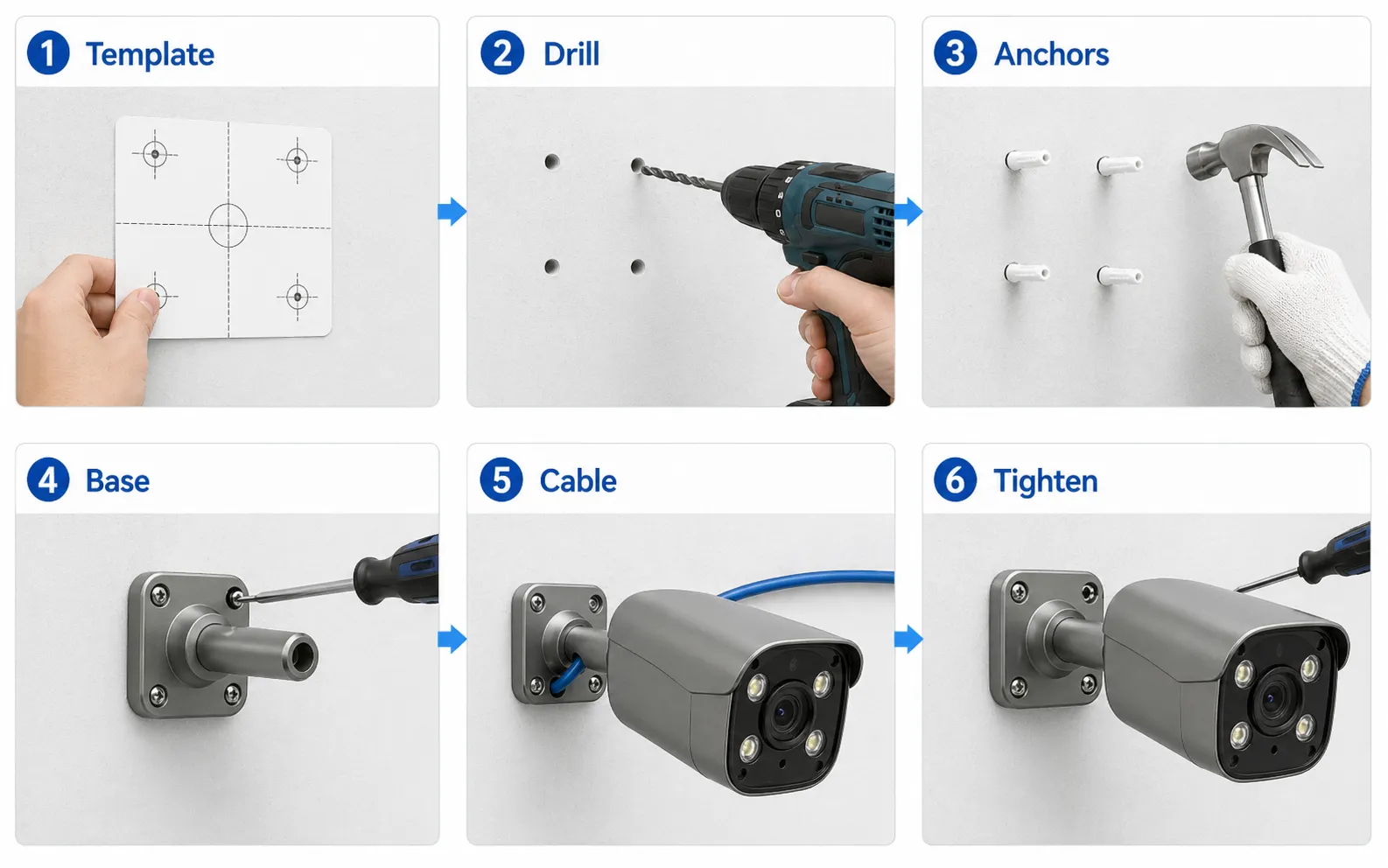
Outdoor security camera installation is more than attaching a camera to a wall. A reliable outdoor surveillance system must consider coverage goals, mounting height, cable routing, weather exposure, power, network stability, lighting, privacy, maintenance, and recording quality. A well-installed outdoor security camera can help document deliveries, vehicles, visitors, entrances, gates, storage yards, and perimeter activity. A poorly installed camera may record glare, shadows, rain spots, blank walls, or unusable night footage.
Outdoor installations are common in home security camera projects and business surveillance system deployments. Homes often need coverage for front doors, garages, side gates, driveways, and backyards. Businesses may need coverage for loading docks, parking lots, warehouse doors, employee entrances, service lanes, and fenced areas. A PoE security camera system is frequently used because wired Ethernet provides stable data and centralized power.
Good outdoor installation is mostly prevention: prevent blind spots, prevent water entering connectors, prevent glare, and prevent a maintenance problem six months later.
How it works
Outdoor camera planning begins with defining the purpose of each view. A camera used for general awareness can be wider and higher. A camera used for identifying a face, reading a package label, or capturing a vehicle plate needs a more targeted view. The installer should walk the site and identify choke points where people or vehicles must pass, such as doors, gates, driveways, stairways, and loading zones.
Mounting height affects both coverage and detail. Mounting too low increases tamper risk. Mounting too high may show the tops of heads and vehicles rather than useful facial or object detail. Many practical installations place cameras high enough to discourage easy tampering but low enough to capture faces at entrances. The correct height depends on lens angle, distance, and target purpose.
Cable routing is a major reliability issue for wired security camera systems. For a PoE camera, Ethernet cable should be routed through protected paths, conduit, or building cavities where appropriate. Exterior cable penetrations should be sealed to prevent water and insects. Cable should avoid sharp bends, physical damage, and routes near high-voltage interference where possible. Outdoor junction boxes and weatherproof connectors help protect terminations.
Weather rating should be matched to exposure. Outdoor cameras often list ingress protection ratings such as IP66 or IP67. These ratings relate to dust and water protection, but they do not automatically guarantee suitability for every environment. Direct sun, freezing temperatures, salt air, dust, vibration, and vandal risk may require additional considerations. NEMA enclosure categories may be relevant in some electrical environments.
Lighting determines image quality. Daytime footage may look excellent, while night footage may be poor if the camera lacks appropriate infrared, visible light, or low-light capability. A night vision camera should be tested at night after installation. Backlight from headlights, streetlights, and reflective walls should also be evaluated.
Features to compare
Field of view is the first tradeoff. Wider views cover more area but reduce detail per person or object. Narrower views capture better detail but cover less area. For important points such as gates or doors, targeted cameras often provide better evidence than one wide overview.
Weather protection includes more than the camera body. The camera, cable connection, mounting surface, and junction box all need protection. A weatherproof camera can still fail if the cable connector is exposed to water.
Glare control should be checked during the day and again at night. Cameras should avoid pointing directly into rising or setting sun when possible. At night, IR light can reflect from walls, soffits, license plates, rain, fog, or insects. Small changes in camera angle can improve the image significantly.
Power stability matters most when conditions get worse. PoE centralizes power and can be connected to a UPS. For outdoor PTZ camera models or cameras with heaters, confirm that the PoE source can supply enough power at the required cable distance.
Maintenance access is easy to forget during installation. Outdoor cameras need occasional cleaning, firmware updates, lens adjustment, and inspection. Mounting a camera where it cannot be safely reached may create long-term maintenance problems.
Match equipment to the site requirements
Choose camera type by location. Bullet cameras are visible and often practical for walls, driveways, and perimeter views. Dome cameras can be better under eaves or in public areas where tamper resistance and appearance matter. Turret cameras, where available, can reduce some dome reflection issues while remaining compact.
Select resolution and lens based on target distance. A 4MP or 5MP outdoor security camera may be sufficient for a doorway or small yard. An 8MP camera may help cover wider areas, but only if storage, lighting, and bitrate are adequate. Varifocal lenses are useful when the final field of view needs adjustment.
Evaluate night requirements. If color detail is important, a full color night vision camera or a camera with white light may be useful. If discreet operation is preferred, infrared black-and-white night vision may be better. For very dark scenes, supplemental lighting can improve all camera types.
Plan storage before installation. Outdoor scenes can have high motion from trees, rain, insects, shadows, and traffic. This can increase bitrate and reduce storage retention. A business surveillance system should estimate storage using realistic outdoor motion conditions.
Consider surge and grounding. Outdoor cables may be exposed to electrical transients, especially on poles, gates, detached buildings, and long exterior runs. Professional installers may use surge protection and proper grounding practices based on local electrical codes.
Privacy must be respected. Cameras should be aimed at the buyer's property and legitimate security areas. Avoid unnecessary views into neighboring windows, private yards, or sensitive spaces. Use privacy masks when needed and follow local laws.
Common Applications
For homes, outdoor cameras commonly monitor front doors, porches, garages, driveways, side gates, patios, yards, and detached buildings. A PoE security camera system is suitable for homeowners who want stable recording to an NVR.
For small businesses, outdoor cameras monitor entrances, delivery doors, parking spaces, dumpsters, service alleys, outdoor seating, storage containers, and employee access points. These cameras can support incident review, safety investigation, and loss prevention.
Warehouses and industrial sites use outdoor cameras for dock doors, fence lines, truck yards, equipment storage, gates, and perimeter roads. PTZ camera models may be added for flexible inspection of large yards.
Farms, rural properties, and construction sites use outdoor cameras for gates, fuel tanks, equipment zones, barns, and temporary work areas. Connectivity and power planning are especially important in these environments.
Common Problems
One common problem is mounting the camera too high. High mounting can reduce tamper risk, but it may record heads and shoulders instead of faces. For identification, the camera must be aimed where people naturally approach.
Another issue is water entering cable connections. Many camera failures are caused not by the camera housing but by exposed connectors. Junction boxes, drip loops, sealing, and proper conduit reduce this risk.
Night glare is also common. IR reflection from nearby surfaces can wash out the image. Insects attracted to IR or visible light can trigger motion alerts and obscure the lens. Adjusting angle, disabling built-in IR in favor of separate lighting, or cleaning regularly may help.
Wi-Fi outdoor cameras may suffer from weak signal after installation. Exterior walls, metal doors, and distance can reduce performance. Wired PoE cameras are usually more dependable for critical outdoor coverage.
Buyers may underestimate maintenance. Outdoor cameras need periodic cleaning and inspection because dust, spider webs, water spots, and vegetation can block the view.
FAQ
What is the best height for outdoor security camera installation?
There is no universal height. The camera should be high enough to reduce tampering but low and angled enough to capture useful detail at the target area.
Should outdoor cameras be wired or wireless?
For critical coverage, wired PoE cameras are usually more reliable. Wireless cameras can work where cable is impractical, but signal should be tested at the final location.
What does IP66 or IP67 mean for cameras?
These ratings describe resistance to dust and water under defined test conditions. They are helpful, but buyers should also consider temperature, sun, mounting, corrosion, and cable protection.
Can outdoor cameras see in complete darkness?
Infrared night vision cameras can record black-and-white images in darkness within their illumination limits. Full color night vision needs visible light or built-in white light.
Do outdoor cameras need surge protection?
In exposed locations, especially poles, gates, and detached buildings, surge protection and grounding should be considered according to local codes and professional practice.
How QuarkView Can Help
Outdoor reliability depends on several earlier choices, so use this guide with PoE camera system guide, bullet vs dome camera placement, night vision setup guide, and wired vs wireless security camera guide to check cabling, camera form factor, lighting, and wireless tradeoffs before installation day.
For QuarkView installation planning, compare PoE camera systems, single PoE cameras, installation accessories, and PoE switches and power supplies based on where cameras will mount, how they will receive power, and what accessories are needed on site.
QuarkView note: QuarkView outdoor system planning checks mounting, cable protection, PoE budget, lighting, and weather exposure together so the installation stays reliable after the first storm or dark night.
Summary
Outdoor security camera installation works best when each camera has a defined purpose, suitable mounting height, protected cabling, weather protection, planned lighting, stable power, enough storage, and a maintainable location. A properly designed outdoor surveillance system captures usable evidence in both day and night conditions. PoE cameras connected to an NVR security system are often a reliable choice for permanent home and business installations.
Reference Sources
- IEC 60529 overview from IEC for ingress protection rating context.
- NEMA Enclosure Types for environmental enclosure context.
- Ethernet Alliance PoE resources for PoE planning background.
- CISA IoT Security for connected device security.
- NIST IR 8259A for cybersecurity capabilities.