
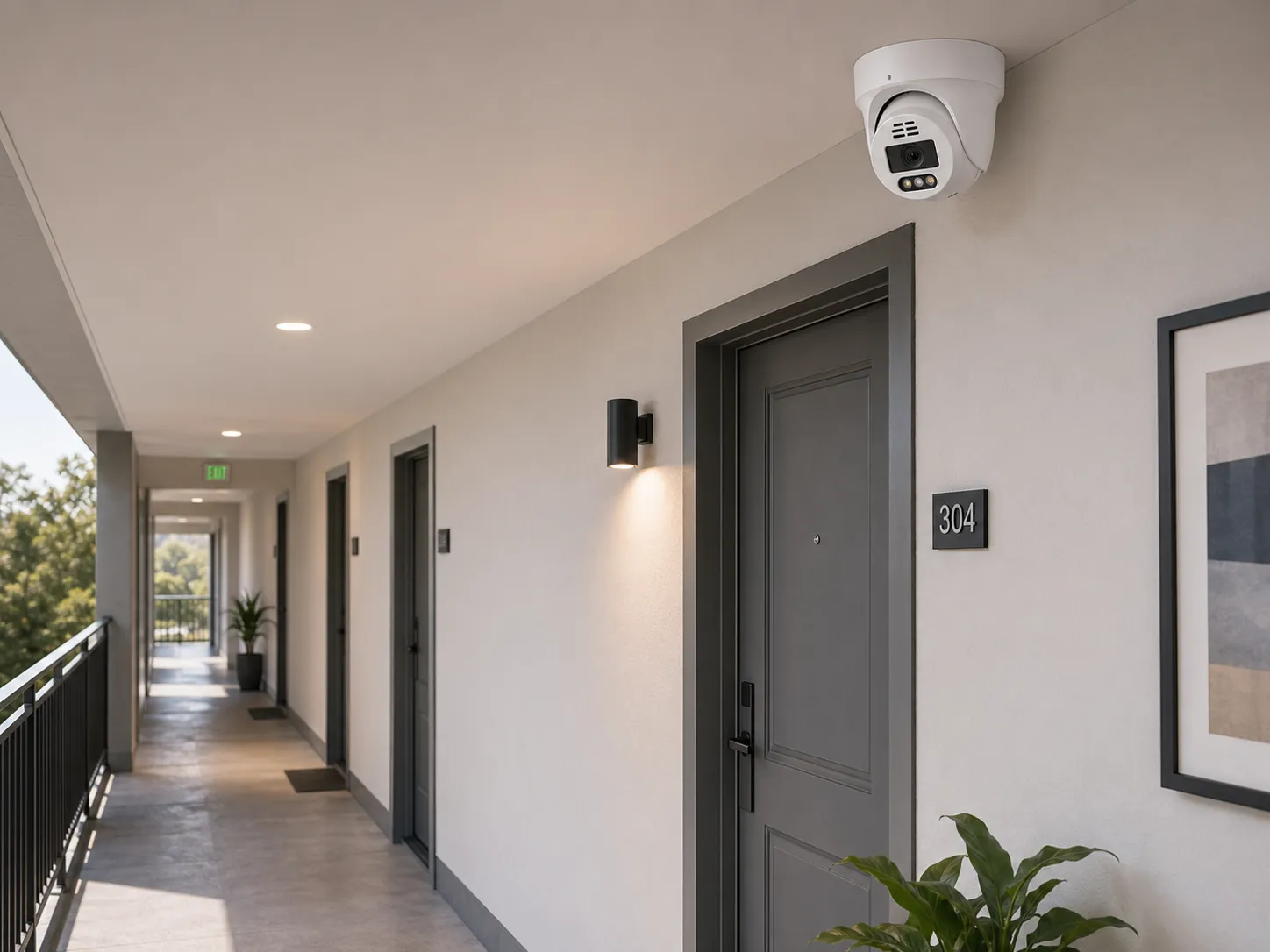
An apartment surveillance system has to balance two goals that sometimes pull against each other: improving safety in shared spaces and respecting resident privacy. Unlike a single-family home, an apartment building includes many people, visitors, deliveries, staff, contractors, vehicles, and common areas. A security camera system can help document incidents, support access control, protect package rooms, discourage vandalism, and improve staff response. At the same time, residents do not want to feel watched in private living areas or targeted by unnecessary monitoring.
For property managers, building owners, homeowners associations, and security integrators, apartment CCTV planning should begin with common-area risk. The question is not "where can we put a camera?" but "which shared areas need documented visibility for safety, operations, or incident review?" Typical zones include entrances, lobbies, mailrooms, package rooms, elevators, corridors, parking garages, bicycle rooms, gyms, laundry rooms, pools, stairwells, loading areas, and exterior paths. Private apartment interiors, bathrooms, locker rooms, changing areas, and other sensitive spaces should not be recorded.
Modern apartment systems may include IP camera networks, a wired security camera backbone, an NVR security system, access control integration, smart motion alerts, and AI surveillance features such as people or vehicle detection. Some buildings also use a PTZ camera for active parking lot monitoring or a panoramic camera for a lobby. Complexity by itself does not solve much. The system has to provide useful evidence, clear policies, reliable retention, and responsible access control.
Plan this project
Use this article to define the requirement, then compare it with Review QuarkView residential security solutions or contact QuarkView for project-level guidance.
Related planning guides
Apartment surveillance planning needs shared-area coverage, resident privacy, remote access, and alert policy to work together. Start with camera placement guide, then compare two-way audio camera limits and remote viewing setup before finalizing the layout. For a deeper operational layer, keep smart motion alerts in the planning path.
When the guide turns into a product shortlist, QuarkView buyers can compare PoE camera systems, WiFi and wireless cameras, NVR recorders based on coverage area, cable path, recording needs, and installation environment.
How it works
Apartment surveillance begins with building flow. Residents, visitors, delivery workers, staff, and vehicles enter through predictable points. Main entrances, side doors, garage doors, elevator lobbies, and package rooms are usually higher-value camera locations than random corridor sections. A camera at an entrance can document who entered. A camera in the lobby can show direction of travel. A camera in the package room can help determine whether a delivery was placed, moved, or removed. Parking cameras can document vehicle movement, damage reports, and suspicious activity.
For most apartment buildings, a PoE security camera system is a solid technical foundation. Power over Ethernet allows each IP camera to receive power and data through one cable, which simplifies installation and centralizes power backup. Cameras can connect to PoE switches or directly to a PoE NVR depending on system size. Larger properties may use multiple network closets, fiber uplinks, VLANs, and a VMS rather than a single recorder.
Camera type should match the location. Dome or turret cameras are common in lobbies, hallways, elevators, and package rooms. Vandal-resistant housings may be needed in public or semi-public areas. Outdoor security camera models should be used at entrances, parking lots, gates, courtyards, and building perimeters. A PTZ camera can support live monitoring of a large parking area, but fixed cameras should still cover entrances, garage gates, and pedestrian paths continuously. Fisheye or multi-sensor cameras can be useful in large lobbies or mailrooms where broad coverage is needed, but close-up identification may still require a separate camera.
Lighting is a common weak point in apartment environments. Lobbies may have glass doors and bright daylight. Parking garages may have uneven light and deep shadows. Outdoor paths may change dramatically at night. Elevators have reflective surfaces and small spaces. The CCTV camera should be tested in the real scene, not judged only by specifications. Wide dynamic range, low-light performance, infrared control, and proper mounting angles all affect evidence quality.
Apartment surveillance also depends on policy design. A camera system records people where they live, receive guests, collect mail, and move through daily routines. Management should define who can view live video, who can search recordings, who can export clips, how requests are handled, how long video is retained, and how residents are informed. In many jurisdictions, signage and privacy notices are expected or required. Audio recording should be treated with extra caution and often disabled unless there is a specific legal review.
Features to compare
Common-area coverage is the starting point. Cameras should be limited to areas where residents and visitors have lower expectations of privacy, such as lobbies, parking garages, entrances, mailrooms, and other shared facilities. They should not be aimed into apartment windows or private unit interiors.
Access control integration saves review time. When a door entry event, fob use, or intercom call can be reviewed alongside video, incident investigation becomes easier. Management may verify whether a door was propped open, whether a visitor followed a resident, or whether a package courier entered at a specific time.
Package room visibility now deserves its own planning. Online shopping has made package theft and delivery disputes common. Cameras should capture the package drop area, entry door, and user activity without exposing private labels more than necessary. Good lighting and a clear angle matter.
Parking coverage should separate overview and detail. A wide outdoor security camera can show general vehicle movement, while cameras at garage gates or driveway choke points can capture better vehicle detail. License plate recognition requires careful angle, shutter speed, lighting, and distance and should not be assumed from a general parking camera.
Resident privacy controls include privacy masking, restricted user permissions, audit logs, retention limits, and written policies. In a residential setting, these are part of the system rather than optional extras.
System health monitoring matters because apartment surveillance often becomes urgent only after a complaint or incident. Cameras, switches, recorders, hard drives, and time synchronization should be checked regularly.
Match equipment to the site requirements
Buyers should start with a site assessment. Identify prior incident patterns, resident concerns, access points, package flow, parking areas, blind spots, lighting problems, and network closets. Walk the site during day and night. Include building staff because they usually know where problems occur.
Choose equipment for durability. Apartment common areas may expose cameras to tampering, vibration, cleaning, humidity, dust, or accidental impact. Vandal-resistant housings and secure mounting are often worth the extra cost in hallways, garages, elevators, and exterior locations.
Confirm system scale. A small building may use an 8- or 16-channel NVR security system. A large residential tower or multi-building property may need distributed PoE switches, higher storage capacity, centralized management, and user permission groups. Plan spare channels and storage expansion.
Evaluate AI surveillance carefully. Person detection, vehicle detection, smart motion alerts, and object search can help staff review events quickly. However, AI should be used for defined safety and operational purposes, not open-ended tracking of residents. Avoid features that create unnecessary privacy concerns unless there is a strong reason and proper governance.
Plan retention based on incident reporting cycles. Package disputes may be reported within days, while parking or vandalism issues may be reported later. Retention should be long enough for practical review, but not unlimited. Longer retention requires more storage and stronger data governance.
Consider remote access security. Managers may need to review footage from an office or mobile device, but remote access should use secure methods, strong credentials, and role-based permissions. Avoid shared admin passwords and direct camera exposure to the internet.
Common Applications
Main entrances and lobbies are the first priority for most apartment surveillance systems. Cameras should capture people entering and leaving, visitor interaction, and direction of movement. A second angle may be needed where glass doors cause backlight.
Package rooms and mailrooms benefit from cameras that show the delivery area, entrance, shelves, lockers, and removal activity. The system should help resolve disputes without overexposing personal information.
Elevators and elevator lobbies are common incident locations. Cameras can help document damage, harassment complaints, falls, and movement between floors. Privacy rules and local elevator camera requirements should be checked.
Parking garages and lots need entry gates, pedestrian paths, vehicle lanes, bicycle storage, and payment or access equipment coverage. Lighting and vandal-resistant mounting are important.
Laundry rooms, gyms, pools, and shared amenities may need cameras at entrances and general public areas. Do not place cameras in changing rooms, bathrooms, saunas, or other private spaces.
Stairwells, service corridors, trash rooms, and loading docks are often overlooked but may be important for access control, vandalism, and staff safety.
Common Problems
Poor resident communication creates trouble quickly. If cameras appear without explanation, residents may assume the worst. Clear notices, policy summaries, and purpose statements can reduce concern.
Broad camera angles can also create privacy issues. A hallway camera that sees into an open apartment door is a simple example. Use careful angles and privacy masks.
Parking footage is often too wide to identify vehicles. Use dedicated choke-point cameras at entrances and exits if vehicle detail matters.
Package room footage may fail because shelves block the view or labels are unreadable. Test real package placement, not an empty room.
Maintenance problems include dirty lenses, failed hard drives, offline cameras, and incorrect timestamps. Apartment systems need routine checks because incidents may be reviewed days later.
Unauthorized access is a serious risk. Staff should not share logins, export clips casually, or use footage for purposes outside policy.
FAQ
Where should cameras be installed in an apartment building? Cameras should focus on shared areas such as entrances, lobbies, elevators, corridors, parking, package rooms, laundry rooms, gyms, and service areas, while avoiding private units and sensitive spaces.
Can apartment cameras record inside resident units? No. Building cameras should not be aimed into private apartment interiors. Careful placement and privacy masking are important near doors and windows.
Is a PoE security camera system good for apartments? Yes. PoE is reliable for multi-camera buildings because it provides power and data over Ethernet and supports centralized recording through an NVR or VMS.
Should apartment systems use AI surveillance? AI can help with people detection, vehicle detection, and faster search in common areas, but it should be limited to clear safety and operational purposes with strong privacy controls.
How long should apartment CCTV footage be stored? Retention depends on local rules, risk, and operational needs. Many properties choose a practical period that covers typical incident reporting while avoiding unnecessary long-term storage.
Who should be allowed to view footage? Access should be limited to authorized management or security personnel with individual accounts, audit logs, and clear rules for sharing clips.
Summary
An apartment surveillance system should protect shared spaces without intruding on private life. Focus cameras on entrances, lobbies, elevators, package rooms, parking, and other common areas. Use reliable wired or PoE infrastructure, apply privacy controls, and document access and retention policies. For QuarkView buyers, residential CCTV is a placement and governance decision as much as a camera purchase.
How QuarkView Can Help
Explore related QuarkView products or contact QuarkView for project support, volume inquiries, and system planning help.
Reference Sources
- Avigilon, residential building and apartment complex security camera guide: https://www.avigilon.com/blog/apartment-building-security-cameras
- Security.org, home and shared-space placement concepts: https://www.security.org/security-cameras/placement-guide/
- GOV.UK, domestic CCTV and privacy guidance: https://www.gov.uk/government/publications/domestic-cctv-using-cctv-systems-on-your-property/domestic-cctv-using-cctv-systems-on-your-property
- ICO, video surveillance data protection principles: https://ico.org.uk/for-organisations/uk-gdpr-guidance-and-resources/cctv-and-video-surveillance/guidance-on-video-surveillance-including-cctv/how-can-we-comply-with-the-data-protection-principles-when-using-surveillance-systems/
- ONVIF, cybersecurity best practices for IP physical security products: https://www.onvif.org/profiles/whitepapers/onvif-recommendations-for-cybersecurity-best-practices-for-ip-based-physical-security-products/