
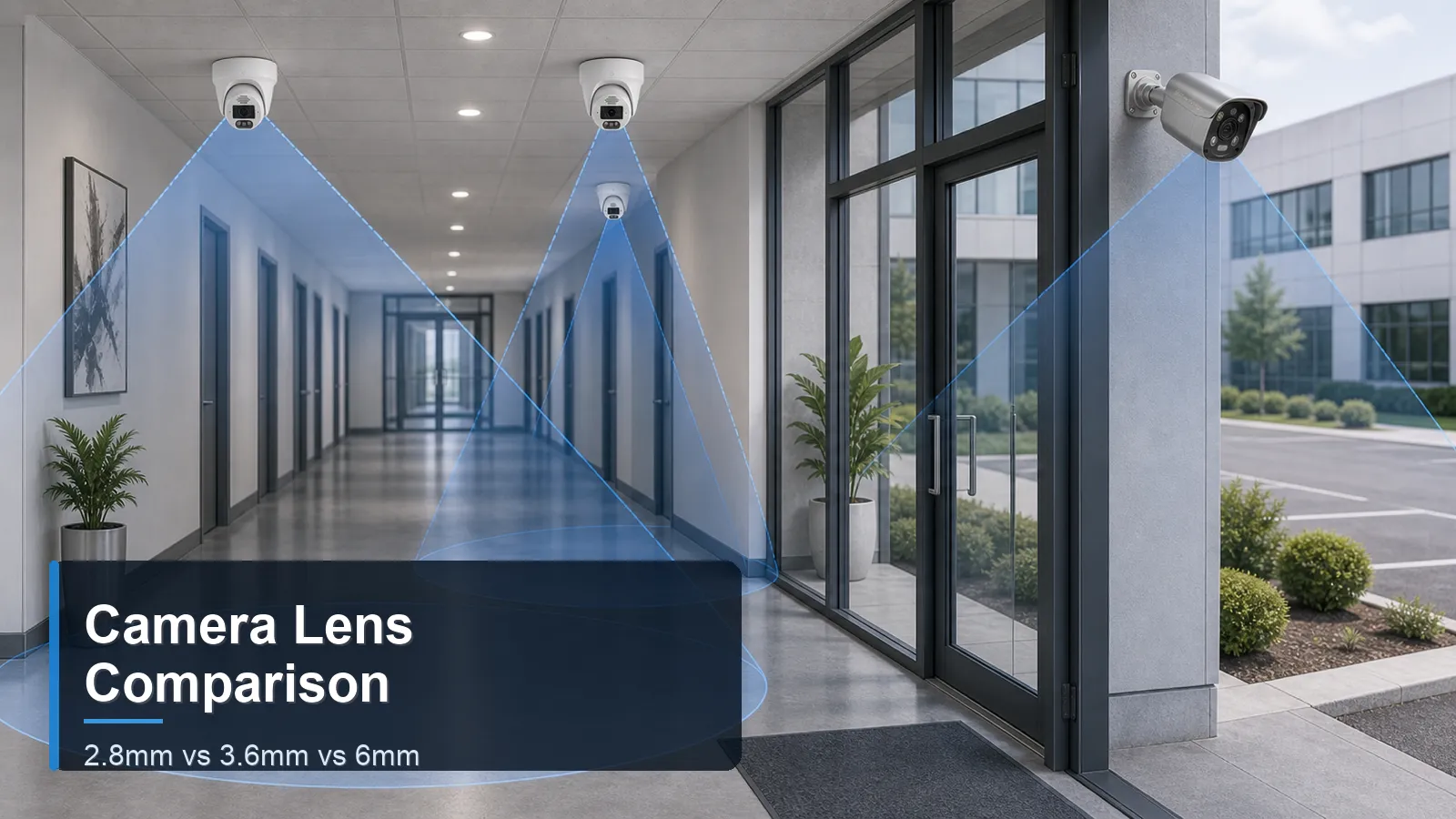
The comparison of a 2.8mm vs 3.6mm security camera lens is really a comparison between coverage and detail. A shorter focal length usually captures a wider field of view. A longer focal length usually captures a narrower field of view with more detail at a given distance. Buyers often choose a camera by resolution first, but lens choice can be just as important for whether the footage is useful.
A CCTV camera, IP camera, or PoE camera may be sold with 2.8mm, 3.6mm, or 6mm fixed lens options. The correct choice depends on scene width, target distance, mounting position, sensor size, and the desired evidence level. A wide lens may show a whole room but not identify a face across the room. A 6mm lens may show a gate clearly but miss activity beside the camera.
How it works
Focal length is measured in millimeters. In general, 2.8mm is considered wide for many security camera designs, 3.6mm is a moderate fixed lens, and 6mm is narrower. Exact field of view varies by camera sensor size and model, so buyers should not assume every 2.8mm camera has the same angle. The manufacturer's field-of-view specification and a site distance estimate should be reviewed together.
A 2.8mm lens is useful when the camera is close to the target or when context matters more than distant detail. Examples include small rooms, front porches, reception areas, and broad indoor overview. It is not ideal when the buyer expects clear identification at the far side of a large yard. The image may look complete, but each person uses fewer pixels because the scene is spread across a wide angle.
Typical use cases for common fixed security camera lenses
Lens
General field behavior
Typical use
Main caution
2.8mm
Wide view with broad context
Small rooms, short entrances, porches, wide indoor overview
Detail drops quickly at distance
3.6mm
Moderate view with more detail than 2.8mm
Doorways, small shops, corridors, general exterior views
May still be too wide for long-distance identification
6mm
Narrower view with more distant detail
Driveways, gates, aisles, targeted entrances, small parking lanes
Misses nearby side context if used as the only camera
A 3.6mm lens is often a balanced choice for entrances, small shops, short corridors, and general exterior views. It sacrifices some width compared with 2.8mm but can improve detail at moderate distances. For many buyers, this is a practical compromise when one camera must provide both context and some recognition. Still, it is not a replacement for a targeted lens when identification is required at a long distance.
A 6mm lens is useful for narrower target areas such as gates, driveways, aisles, small parking lanes, or long approaches. It can place more pixels on a person or vehicle at distance, but it covers less side area. In a business surveillance system, a 6mm lens may be paired with a wider overview camera so the NVR security system records both context and detail.
Mounting height and angle can change the result as much as focal length. A 3.6mm camera mounted near eye level at an entrance may capture better face detail than a higher-resolution camera mounted high under a roof eave. A 6mm camera aimed too steeply down a driveway may miss faces in vehicles or people walking close to the wall. Lens choice should therefore be tested with the intended mounting position, not only selected from a catalog table.
A QuarkView CCTV system planning guide method is to choose lens size after defining target distance, not before.
Features to compare
Field of view is not only horizontal. Vertical field of view matters for doors, counters, stairs, and mounted height. A camera mounted too high with a wide lens may show floor area but weak facial detail.
Pixel density is the practical measurement behind lens choice. The same 4MP camera produces different evidence value depending on how wide the lens is and how far the target is from the camera.
Sensor size affects the field of view produced by the same lens number. A lens listed as 3.6mm on one camera may not produce exactly the same angle on another camera with a different sensor.
Target width should be estimated in real units. If the important view is a two-meter doorway, choose a lens that frames that doorway with enough surrounding context instead of using a lens that shows an entire courtyard without detail.
Varifocal cameras can be adjusted after installation and may be useful when the buyer is unsure of the exact field of view. Fixed-lens cameras are simpler and often lower cost, but they require better planning.
Check viewing distance and recorded detail
Measure the target distance before selecting the lens. If the important point is three meters from the camera, a 2.8mm lens may be fine. If the important point is twelve meters away at a gate, a 6mm or varifocal option may be more appropriate. Distance should be considered along with mounting height and target direction.
Do not solve every problem with wide angle. Wide lenses are attractive because they reduce camera count, but they can create a false sense of coverage. For entrances, cash areas, and vehicle choke points, detail may be more important than showing the entire surrounding area.
Plan lens selection together with surveillance storage and bandwidth. A narrower lens does not automatically increase bitrate, but buyers may choose higher resolution or higher bitrate for detail cameras. The NVR should have enough capacity to record the selected camera mix.
For outdoor security camera projects, consider weather, sunlight, and night lighting. A long driveway view with a 6mm lens may work during the day but fail at night if IR range, motion blur, or headlights reduce detail.
Ask for sample still images or a site mock-up when the view is important. If possible, temporarily hold a camera at the planned position and record a person or vehicle at the target distance. Comparing a 2.8mm, 3.6mm, and 6mm view from the same location is often clearer than debating specifications.
Common Applications
A 2.8mm lens is common in small rooms, home porches, reception areas, elevators, and general overview positions. It is useful when the buyer wants to see activity rather than identify distant subjects.
A 3.6mm lens is common at shop entrances, corridors, small offices, and exterior wall positions. It is often a balanced option for a PoE security camera system with mixed indoor and outdoor views.
A 6mm lens is common for gates, warehouse aisles, loading doors, long corridors, parking lanes, and targeted entry points. It is often paired with wider cameras in a wired surveillance system.
Common Problems
The first problem is choosing the widest option because it shows more on the screen. The recorded image may not provide enough detail for recognition or identification.
The second problem is choosing a narrow lens without considering nearby activity. A 6mm camera may capture the gate but miss someone standing below or beside the camera.
The third problem is ignoring sensor size. Lens millimeters are helpful, but the camera's actual field-of-view specification is more reliable for comparing models.
A fourth problem is relying on digital zoom after recording. Digital zoom enlarges existing pixels; it does not create the detail that would have been captured by a better lens choice or a closer camera position.
FAQ
Is 2.8mm better than 3.6mm?
Neither is always better. 2.8mm is wider. 3.6mm is narrower and can provide more detail at moderate distance.
When should I use a 6mm security camera lens?
Use 6mm for targeted views such as gates, driveways, aisles, and entrances where the subject is farther from the camera.
Does higher resolution fix a wide lens?
Higher resolution helps, but it does not fully replace correct lens selection and camera placement.
Should I buy fixed lens or varifocal?
Fixed lens is simple when the site is known. Varifocal is useful when the exact view must be adjusted after mounting.
What lens is best for a front door?
A short or moderate lens is common, but the best choice depends on mounting distance, door width, and whether face detail is required.
Summary
Choosing between 2.8mm, 3.6mm, and 6mm lenses means balancing wide context against target detail. Buyers should measure distance, check actual field of view, and choose lens size according to the evidence required from each camera position.
Prepared for international buyers by the QuarkView Security Learning Center, this guide supports CCTV camera lens selection, IP camera field-of-view planning, PoE camera installation, NVR security system design, wired surveillance system coverage, surveillance storage planning, outdoor security camera placement, and business surveillance system quotations.
Plan Your Security Camera System With QuarkView
If you are comparing 2.8mm, 3.6mm, and 6mm security camera lenses, field of view, corridor coverage, and entrance detail, explore related QuarkView products or contact QuarkView for project and volume inquiry support.
Related QuarkView Planning Resources
For the next planning step, compare 4MP vs 5MP vs 8MP Security Cameras Explained, Wide Angle vs Zoom Security Cameras: Field of View and Detail Explained, How to Choose a 4K Security Camera System: A Buyer's Guide, ColorVu-Style Full Color Cameras vs Infrared Cameras Explained, Common CCTV Installation Mistakes and How to Avoid Them. These related guides connect product selection, placement, recording, installation, and long-term reliability decisions.
Related QuarkView Collections
Reference Sources
- Axis Communications. Lenses in surveillance. Source link (https://whitepapers.axis.com/en-US/lenses-in-surveillance)
- Axis Communications. Pixel density and DORI. Source link (https://whitepapers.axis.com/en-us/pixel-density-and-dori)
- ONVIF. ONVIF Profiles for IP-based physical security products. Source link (https://www.onvif.org/profiles/)
- Western Digital. Surveillance / CCTV storage capacity estimator. Source link (https://www.westerndigital.com/solutions/surveillance)