
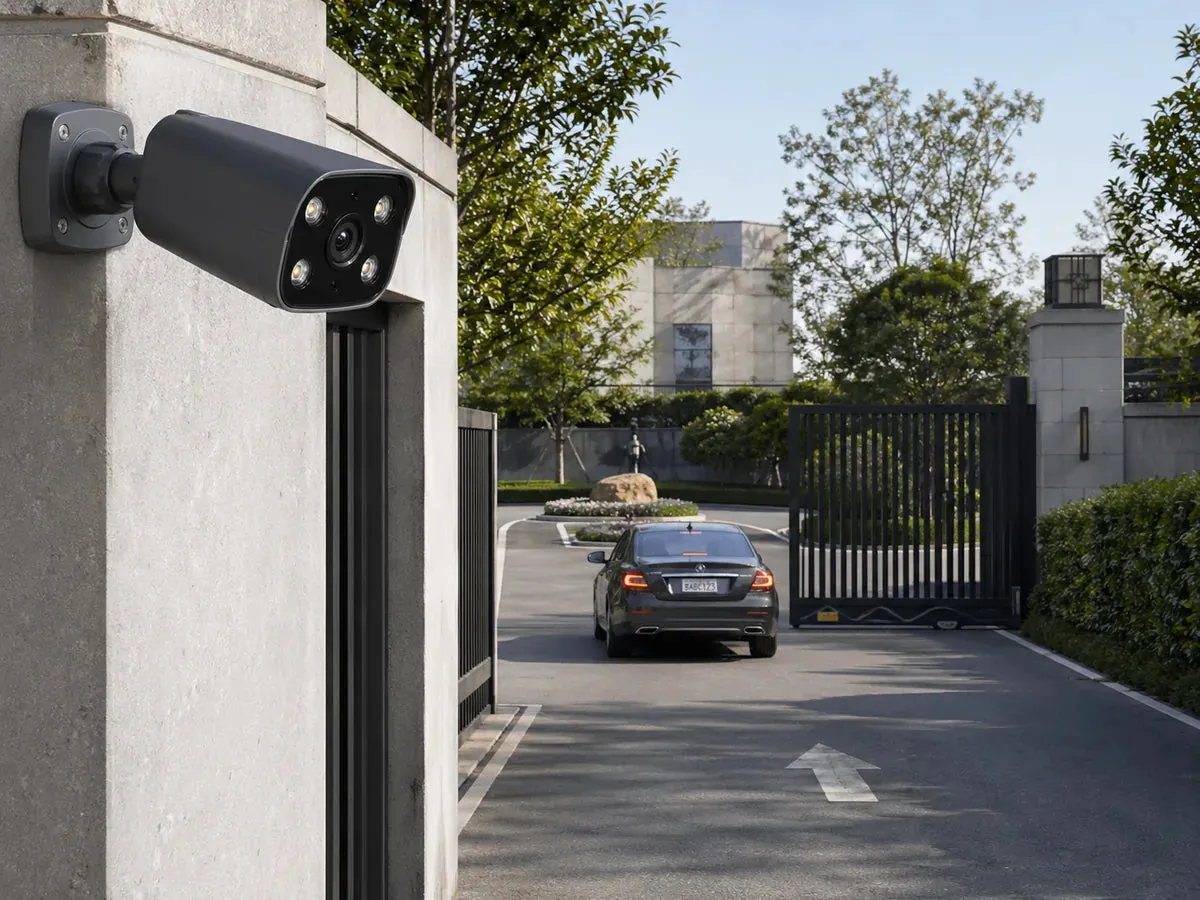
QuarkView Security Learning Center. This guide is part of QuarkView's practical security camera knowledge base for home, retail, office, warehouse, installer, and small business projects.
Use it to clarify requirements before comparing PoE camera systems, NVR recorders, outdoor cameras, wireless cameras, and accessories.
Choosing between a wide angle and a zoom security camera is one of the most important decisions in a surveillance system design. Many buyers want a camera that can "see everything," but video surveillance always involves a tradeoff between coverage and detail. A wide angle camera covers more of the scene, while a zoom or narrow-angle camera concentrates pixels on a smaller target area. Both can be useful. Problems happen when a buyer expects one camera to do both jobs at once.
The search phrase is wide angle vs zoom security camera, but the buying decision is really about field of view. Field of view describes how much of a scene is visible through the lens. Detail describes how much useful information the video contains about a person, object, face, license plate, package, vehicle, or event. A camera can have a wide field of view and still fail to capture identity-level detail. Another camera can capture excellent detail at a doorway but miss activity just outside that narrow view.
Match scene width and required target detail to the lens. Compare fixed, varifocal and optical-zoom choices using recorded day and night views; digital zoom enlarges the captured image.
How it works
Field of view is controlled mainly by the lens focal length, camera sensor size, and image format. A shorter focal length produces a wider view. A longer focal length produces a narrower view with more magnification. A 2.8 mm lens is often considered wide angle in many common security camera formats. A 4 mm or 6 mm lens provides a narrower view. A 12 mm lens is much narrower and may be used to view a gate, hallway end, or specific target area at distance. Exact angles vary by sensor and camera design, so check the manufacturer specification or use a field-of-view calculator.
Resolution interacts with field of view. Suppose two 4MP cameras use the same sensor resolution, but one has a wide lens covering a 100-degree view and the other has a narrower lens covering 40 degrees. The wide camera spreads its pixels over a larger area. It may show more context, but each face or object may occupy fewer pixels. The narrow camera captures fewer objects, but each object may be larger in the frame. This is why wide angle views are good for awareness and movement, while zoomed or narrow views are better for detail.
Optical zoom and digital zoom are often confused. Optical zoom uses the lens to magnify the scene before the image reaches the sensor. It preserves real detail because the target occupies more sensor pixels. Digital zoom enlarges the recorded image after capture. It can help a viewer inspect part of the frame, but it cannot recover detail that was not captured originally. If a face is only 20 pixels tall in the recording, digital zoom will make a larger blurry face, not a better face.
Varifocal cameras allow lens adjustment during installation. A motorized varifocal IP camera may be adjusted through software to set the desired field of view after mounting. This is useful when the installer is not sure which lens angle is required until testing the real scene. A fixed lens camera is simpler and often lower cost, but the field of view is determined at purchase.
A PTZ camera adds pan, tilt, and optical zoom movement. It can cover wide areas through presets and zoom into events when controlled manually or through automation. However, a PTZ camera records only the direction it is looking at. If it is zoomed into a gate, it may miss activity behind it. For this reason, many business surveillance system designs use fixed wide-angle cameras for continuous overview and PTZ cameras for active investigation.
Features to compare
A wide angle camera has a broad field of view. It is useful for rooms, lobbies, small shops, yards, and general situational awareness. It may not provide strong detail at distance.
A zoom camera uses optical zoom or a narrow lens view. It is useful for entrances, gates, parking lanes, cash desks, hallways, and target zones where detail matters.
A varifocal lens can change focal length within a range, such as 2.8-12 mm. It helps installers tune the view after mounting instead of committing to one fixed angle before seeing the real scene.
Optical zoom is physical lens magnification. It captures more real detail because the subject is larger on the sensor.
Digital zoom is software enlargement of recorded or live video. It helps inspection but does not create detail that was not captured.
Pixels on target is a practical way to think about evidence quality. It asks how many pixels cover the object or person of interest. More pixels on target usually means more useful detail, assuming lighting, focus, and compression are acceptable.
DORI-style planning separates detection, observation, recognition, and identification. The farther the target and wider the lens, the harder it is to reach the higher detail levels.
Very wide lenses may create edge distortion. This may be acceptable for overview but less suitable for measurement, identification, or clean face capture.
Check viewing distance and recorded detail
Start with the question: What must this camera prove? If the purpose is to know whether someone entered a backyard, a wide angle outdoor security camera may be enough. If the purpose is to capture a clear face at a gate, the camera needs a tighter view, lower mounting angle, and suitable lighting. If the purpose is to watch a parking lot generally and zoom into incidents, a PTZ camera may be useful, but fixed overview cameras should still cover critical areas.
For a home security camera system, wide angle cameras are common at front porches, garages, side yards, and indoor common areas. But a wide front-door camera may not capture a clear face if visitors stand too close, under strong backlight, or at the edge of the frame. A door-facing camera should be mounted and aimed to capture faces at expected approach height. For driveways, a wide camera can show vehicles entering, but a narrower camera may be needed if plate or driver detail is required.
For retail, wide angle cameras work well for aisles, customer areas, and general store coverage. Checkout counters may need a more targeted lens because transaction disputes require detail. Entrances often require a camera aimed at face height or an angle that avoids backlight from the street. A single ceiling camera in the middle of a store may show activity but miss useful details at the doorway.
For warehouses, wide angle cameras can cover loading docks or large aisles, but they may not identify small labels, faces, or vehicle details at distance. Use narrow or varifocal cameras for dock doors, high-value storage cages, and gate points. A PTZ camera can support yard monitoring, but fixed cameras should still cover entrances and safety-critical zones.
For outdoor perimeter applications, lens planning is critical. A camera looking down a fence line may need a narrower view to see distance clearly. A wide lens may show the entire fence corner but fail to show activity at the far end. Lighting, IR range, mounting height, and weather rating should all be considered.
When comparing product specifications, do not look only at "wide angle 120 degrees" or "30x zoom." Ask whether the angle and zoom range match your required target distance. Check image quality at the intended zoom, low-light performance, autofocus behavior, WDR, and whether the NVR security system supports the PTZ controls or motorized lens adjustment you need.
Common Applications
Wide angle cameras are commonly used in living rooms, small shops, cafes, reception areas, classrooms, open office spaces, stock rooms, and short driveways. They provide context and help users understand movement through the scene.
Zoom or narrow-angle cameras are used at entrances, gates, cash registers, loading docks, parking lanes, hallway ends, long corridors, and restricted doors. They are chosen when detail matters more than broad context.
PTZ cameras are common in parking lots, campuses, industrial yards, warehouses, ports, and large open areas. They can follow activity, use presets, or zoom in when an operator needs more information. They are most effective when combined with fixed cameras.
Fisheye or panoramic cameras are used where a broad 180-degree or 360-degree view is needed, such as small retail spaces or hallway intersections. They are useful for overview but should not be treated as a replacement for targeted identification cameras.
AI surveillance applications may require specific field-of-view planning. Human detection and vehicle detection work better when the target is large enough in the frame and the angle is suitable. A very wide camera mounted high may reduce detection quality for distant targets.
Common Problems
One common problem is overusing wide angle cameras. The video looks impressive because it shows a large area, but a person at the far side of the image is too small to identify. This is a design issue, not necessarily a camera defect.
Another problem is relying on digital zoom after an incident. Buyers may assume they can zoom in later like in entertainment media. In real surveillance video, recorded detail is limited by pixels, focus, compression, motion blur, and lighting.
PTZ misuse is also common. A PTZ camera may be pointed away from the incident when it happens. Unless it is actively monitored or paired with reliable presets and fixed cameras, it can leave blind spots.
Very wide lenses can create edge distortion. People at the edges may appear stretched, and lines may curve. For overview this may be acceptable, but for evidence detail it can be a problem.
Incorrect mounting height reduces detail. A camera mounted high with a wide lens may capture the tops of heads rather than faces. For identification, camera angle and target size are just as important as megapixels.
Low light can erase the benefit of zoom. A narrow view may capture more target detail during the day, but at night it may need stronger IR, a larger aperture, lower shutter speed, or better lighting. Motion blur at night can make faces unreadable.
FAQ
Is a wide angle security camera better?
It is better for broad coverage, but not always for detail. Wide angle cameras are useful for overview, while zoom or narrow-angle cameras are better for target detail at distance.
What is the difference between optical and digital zoom?
Optical zoom uses the lens to magnify the scene before recording. Digital zoom enlarges the recorded image and cannot create missing detail.
Should I buy a fixed lens or varifocal camera?
A fixed lens is simple when the required view is known. A varifocal camera is useful when the installer needs to adjust the angle after mounting.
Can a PTZ camera replace multiple fixed cameras?
Usually no. A PTZ camera can move and zoom, but it cannot continuously record every direction at once. Use fixed cameras for critical constant coverage.
What lens is best for a front door?
It depends on distance and mounting position. Many front doors need a moderate field of view that captures approach context and face detail without too much edge distortion.
Why is my recorded face too small?
The lens may be too wide, the camera may be too far away, or the mounting angle may be wrong. Use a narrower lens, move the camera closer, or add a dedicated identification view.
Does higher resolution solve field-of-view problems?
Higher resolution can help, but it does not replace proper lens selection. A wide 8MP camera may still capture less useful detail than a well-aimed narrower camera for a specific target.
How should I plan a business surveillance system?
Use wide cameras for context and targeted cameras for entrances, counters, gates, and other detail points. Build the plan around required evidence rather than camera count alone.
Related QuarkView Planning
Field of view decisions become easier when you also review security camera lens basics, the PTZ camera technology guide, and the dual lens security camera guide. If you are comparing image detail across resolutions, the article on 4MP vs 5MP vs 8MP security cameras helps connect lens choice with usable evidence.
For real projects, compare QuarkView single PoE cameras, AI camera systems, and PoE camera systems by scene width, subject distance, mounting height, and whether the site needs fixed coverage or zoom review.
Summary
Wide angle vs zoom security camera selection comes down to coverage and detail. Wide angle cameras show more of the environment. Zoom and narrow-angle cameras place more pixels on the target. A complete surveillance system often uses both: wide views for awareness and targeted views for evidence. Before buying, define what each camera must capture, estimate target distance, consider lighting, and choose the lens type from there. Better field-of-view planning will do more for the footage than simply buying the highest resolution camera available.
Plan Your Security Camera System With QuarkView
Explore related QuarkView products or contact QuarkView for project and volume inquiry support.