
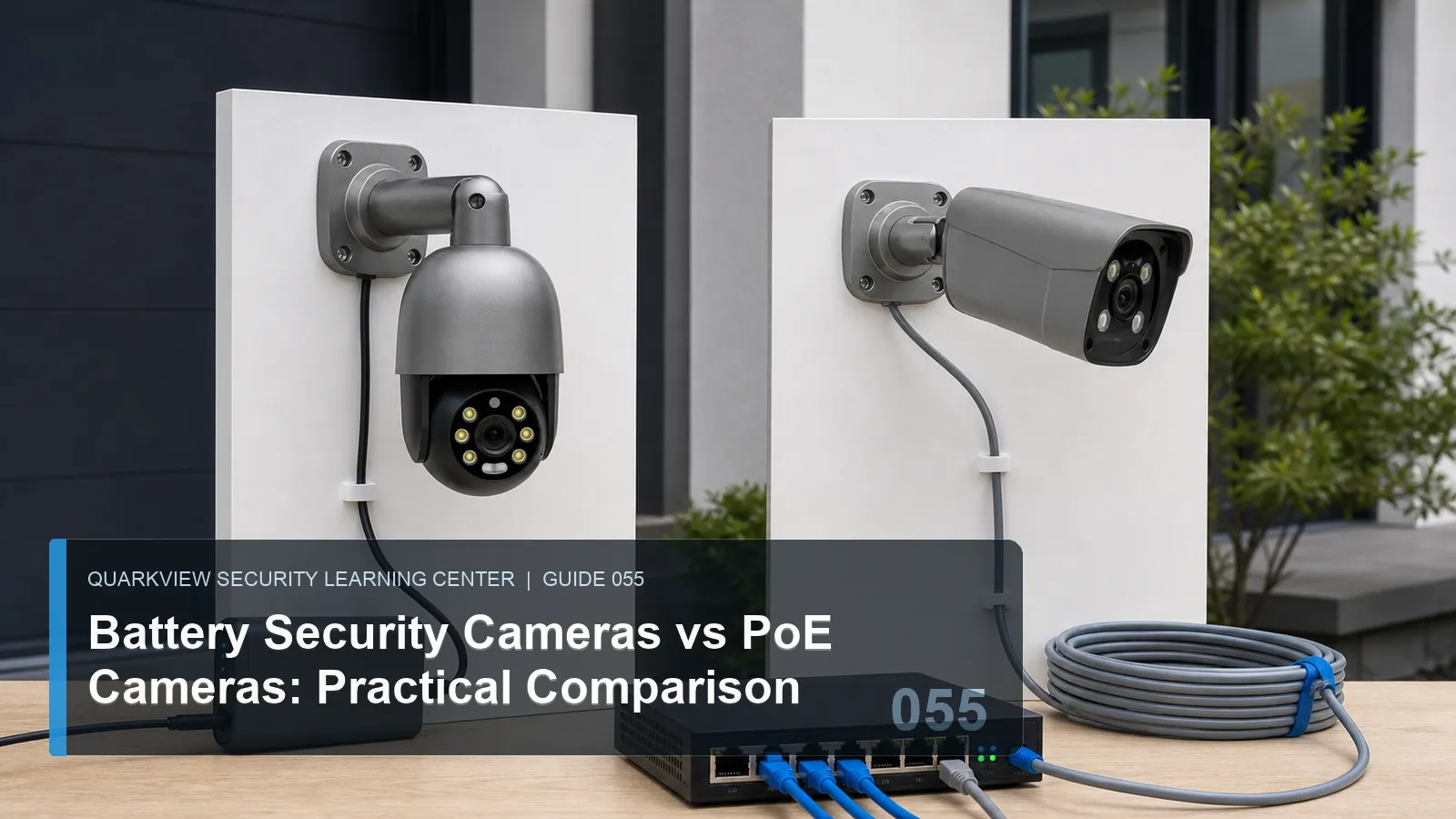
The wired vs wireless security cameras decision comes down to reliability, convenience, installation cost, and maintenance. A wired security camera uses a physical cable for data transmission and often for power. A wireless security camera uses Wi-Fi or another wireless link for data, although many still need a power cable. Battery cameras are a separate category because they are wireless for both data and routine power, but they have different recording behavior and maintenance requirements.
For home security camera projects, wireless cameras can be attractive because they are quick to install and easy to move. For business surveillance system projects, wired cameras are often preferred because they offer more predictable recording, better bandwidth, and less dependence on radio conditions. A PoE security camera system is the most common wired IP design because one Ethernet cable can deliver both power and data to each PoE camera.
The better choice depends on what the camera must record, how often it must record, and how much maintenance the owner is willing to accept.
How it works
A wired surveillance system may use coaxial cable with a DVR or Ethernet cable with an NVR. In modern IP camera deployments, wired usually means Ethernet. A PoE camera connects to a PoE switch or PoE NVR and sends video data over the same cable that powers the device. This design gives each camera a dedicated physical path for communication.
A wireless security camera sends data through Wi-Fi or another wireless technology. The camera may still be powered by a wall adapter, solar panel, or battery. Wireless cameras communicate through access points or routers, so their performance depends on signal strength, interference, walls, distance, network congestion, and router quality.
The key technical difference is transmission predictability. Ethernet provides stable bandwidth and low latency within its design limits. Wi-Fi shares radio spectrum with phones, laptops, tablets, smart TVs, neighboring networks, and other devices. Wi-Fi can work very well, but it is more variable. In a busy apartment building or a metal-heavy warehouse, wireless cameras may be less stable than wired security camera designs.
Power is another difference. PoE centralizes camera power at the switch or NVR. Wireless plug-in cameras still need outlets near the camera location. Battery cameras avoid cable installation but usually reduce continuous recording, frame rate, pre-event capture, or detection frequency to conserve power. This can be acceptable for casual home monitoring but less suitable for critical surveillance.
Network security also differs. Wired cameras are physically connected, while wireless cameras depend on Wi-Fi encryption, password strength, router security, and device firmware. Both designs can be secure or insecure depending on setup, but wireless adds another access layer that must be managed.
Features to compare
Uptime is the first thing to check. For a security camera, the useful question is whether it records when something happens. Wired cameras generally provide better uptime because they are less affected by wireless interference and battery depletion. Wireless cameras can still be dependable when signal quality is strong and power is stable.
Installation flexibility is where wireless cameras earn their place. They are easier to install in finished homes, rental properties, or temporary locations where running cable is difficult. Wired systems require cable routes, drilling, conduit, patch panels, or professional installation, but they are cleaner and more reliable after installation.
Recording mode changes the user experience. Wired PoE systems often support 24/7 recording to an NVR security system. Battery wireless cameras often use event-based recording to save power. Event-based recording may miss the beginning of an event or fail to record continuous context.
Bandwidth becomes a real constraint as the system grows. A multi-camera wireless system can overload a weak Wi-Fi network, especially with high-resolution cameras. Multiple 4MP or 8MP streams can consume significant airtime. Wired systems can use gigabit switches and dedicated uplinks to handle higher loads.
Scalability is where wired systems usually pull ahead. Adding one wireless camera may be easy. Adding sixteen wireless cameras may be difficult if the access point cannot handle the load. A wired PoE security camera system is easier to scale in a controlled way because each camera has a cabled connection and a known power budget.
Match equipment to the site requirements
Buyers should first classify each camera location by importance. Critical views such as entrances, cash registers, loading docks, gates, and parking lot choke points usually deserve wired cameras when possible. Less critical views, temporary monitoring, or rental-friendly locations may be acceptable for wireless cameras.
Installation cost should include labor and future maintenance. Wireless cameras may reduce initial labor, but plug-in models still need outlets and cable management. Battery models require charging, battery replacement, or solar exposure. Wired cameras cost more to install but can require less routine attention once properly mounted and connected.
Check the building environment. Thick walls, metal doors, concrete, elevators, machinery, and crowded wireless networks can weaken Wi-Fi. Outdoor wireless cameras may work near the router but fail at the final mounting point. Buyers should test signal strength where the camera will actually be installed.
Match the connection to the video quality expectation. A high-resolution outdoor security camera needs stable bandwidth to upload video. If Wi-Fi fluctuates, the camera may lower bitrate, disconnect, or delay alerts. Wired systems are better for continuous high-resolution recording.
Power backup also matters. A PoE switch and NVR can be connected to a UPS, keeping multiple cameras online during short outages. Wireless cameras powered by scattered wall adapters may need multiple backup points. Battery cameras may continue operating during an outage, but the router or internet connection may not.
For cybersecurity, use strong Wi-Fi encryption, strong unique passwords, firmware updates, and separate guest or IoT networks where possible. For businesses, cameras should not share the same flat network as point-of-sale systems, accounting computers, or sensitive workstations unless properly segmented.
Common Applications
Wired systems are common in business surveillance system projects. Retailers, warehouses, offices, restaurants, and workshops often require stable recording and predictable playback. PoE systems are also common in higher-end home security camera installations where the homeowner wants long-term reliability.
Wireless cameras are common for apartments, rental homes, temporary construction areas, and smaller residential monitoring tasks. They can cover porches, nurseries, pets, garages, and short-term problem areas with less installation effort.
Hybrid systems are also practical. A property may use wired PoE cameras for critical perimeter and entrance coverage, while using wireless cameras for temporary or less critical views. An NVR security system may support wired IP cameras, while separate wireless cameras may use their own app or cloud service.
In rural sites, wireless bridges can connect outbuildings, gates, or barns to the main network. This is different from consumer Wi-Fi cameras and requires careful line-of-sight planning, weatherproof equipment, and power at each end.
Common Problems
Wireless camera dropouts are common when cameras are installed at the edge of Wi-Fi coverage. Signal bars in an app can be misleading because upload stability, packet loss, and interference matter. Repositioning access points or adding wired backhaul can improve performance.
Battery maintenance is another common issue. A camera may work well in summer but drain quickly in winter, in high-traffic scenes, or when frequent alerts keep waking the device. Buyers should check realistic battery performance expectations, not only ideal lab claims.
Wired systems can have cable-related problems. Poor termination, damaged cable jackets, water ingress, or low-quality cable can create intermittent faults. Outdoor cable routes need weather protection, drip loops, conduit where appropriate, and surge considerations.
Another problem is assuming wireless means no wires. Many wireless security cameras still need power adapters. If there is no outlet near the mounting location, installation may still require an electrician or a different camera type.
For both systems, poor placement is a major issue. A camera pointed into direct sun, mounted too high, or placed behind reflective glass may produce weak evidence regardless of wired or wireless connection.
FAQ
Are wired security cameras more reliable than wireless cameras?
Usually yes, especially for continuous recording and business use. Wired cameras are less affected by wireless interference and shared network congestion.
Are wireless cameras easier to install?
Yes, in many cases. They are useful where running cable is difficult, but plug-in models still need power and battery models need maintenance.
Can wireless cameras record 24/7?
Some plug-in wireless cameras can, but battery cameras usually record events rather than continuous video to conserve power.
Is PoE considered wired?
Yes. A PoE security camera system is a wired IP camera system that uses Ethernet for both power and data.
Which is better for small businesses?
For critical coverage, wired PoE cameras connected to an NVR security system are generally preferred. Wireless cameras may be useful for supplemental or temporary views.
How QuarkView Can Help
Before choosing wired or wireless, it helps to compare this article with PoE security camera system guide, outdoor installation guide, night vision planning, and NVR and DVR recorder differences so cable routes, mounting conditions, night coverage, and recorder needs are judged in the same plan.
QuarkView buyers can compare wired PoE camera systems, WiFi and wireless cameras, solar and battery cameras, and PoE switches and power depending on whether the site favors structured cabling, flexible wireless placement, or locations without easy power.
QuarkView note: For permanent home or business installs, QuarkView usually treats wired PoE as the baseline for stability and uses Wi-Fi or battery cameras where cabling is impractical.
Summary
Wired vs wireless security cameras should be evaluated by purpose, not trend. Wired PoE camera systems provide better reliability, centralized power, scalable bandwidth, and continuous recording. Wireless cameras provide convenience, flexibility, and lower installation friction. Many buyers use both, with wired cameras for critical security coverage and wireless cameras for flexible monitoring. The right choice depends on site conditions, camera importance, power availability, Wi-Fi quality, storage needs, and maintenance expectations.
Reference Sources
- CISA IoT Security for securing connected cameras and IoT devices.
- NIST IR 8259A for IoT cybersecurity capability guidance.
- Ethernet Alliance PoE resources for PoE background.
- FTC guidance on securing home Wi-Fi for wireless network security basics.
- ONVIF Profiles for IP camera interoperability context.