
Decision summary
Quick answer
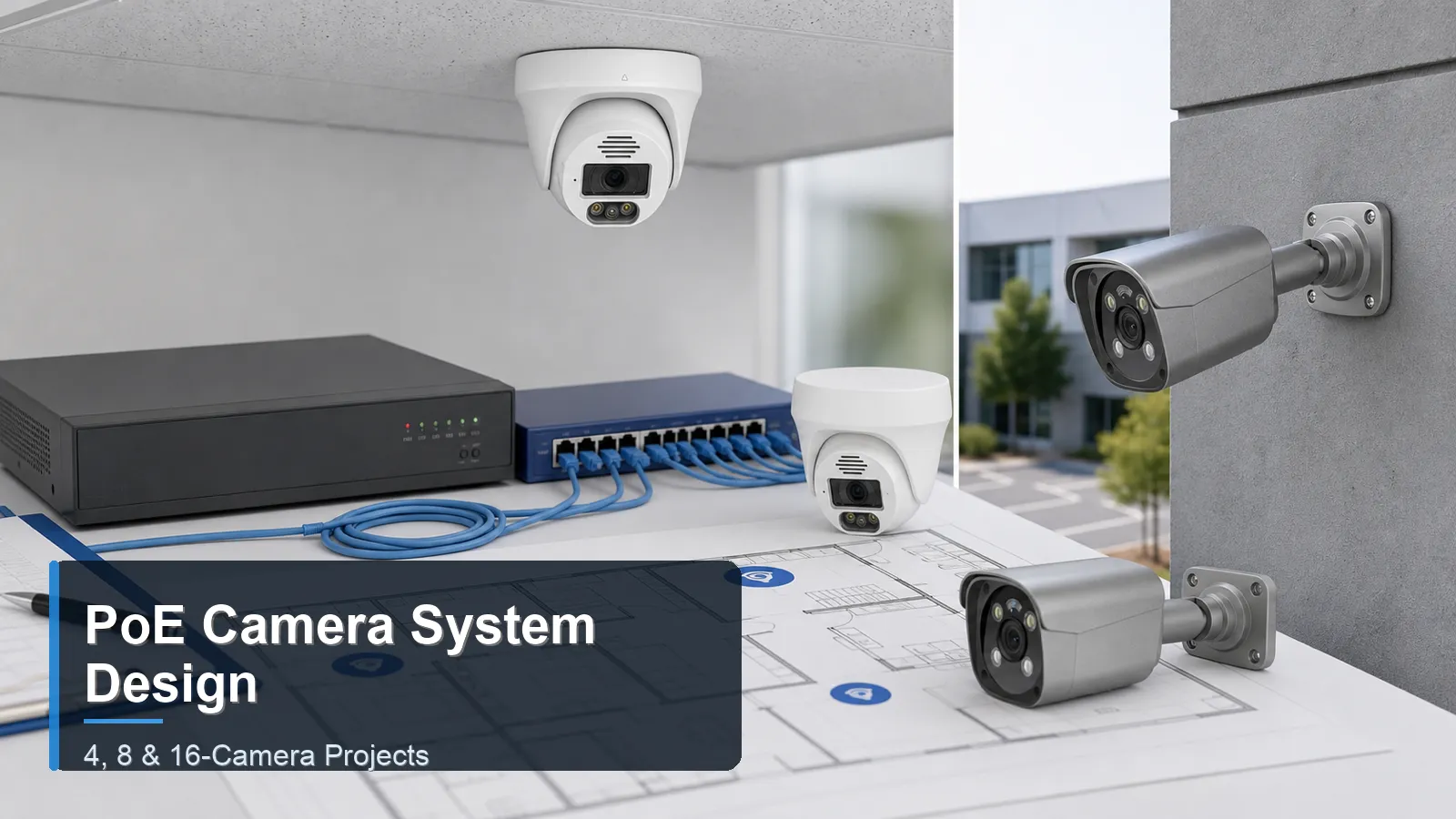
A PoE camera system carries power and video over Ethernet between compatible cameras and a PoE power source. The NVR records the streams; the router provides the path for internet access when remote viewing is needed. Understanding these separate roles is the first step before comparing kits.
- Identify the camera, power source, recorder and local network before choosing quantities.
- Recorder channels, physical PoE ports and total power are separate limits.
- Local recording and remote internet access have different dependencies; check the exact models and setup.
A PoE security camera system is a wired surveillance system that sends both network data and electrical power through one Ethernet cable. PoE stands for Power over Ethernet. In practical CCTV and IP camera projects, PoE allows an installer to connect a PoE camera to a PoE switch or PoE NVR without running a separate power adapter to every camera location.
For buyers comparing a CCTV camera package, an IP camera kit, or a modern NVR security system, PoE is worth understanding before the camera count is fixed. It affects installation cost, camera placement, network stability, maintenance, and later expansion. A PoE security camera system is common in homes, retail stores, warehouses, offices, restaurants, parking areas, schools, and small business security projects where stable recording matters more than the lowest possible upfront cost.
The practical questions are straightforward: what hardware is needed, how much power is available, how far the cable can run, and what can go wrong after installation. Those questions matter more than the wording on the kit box.
How it works
In a traditional analog CCTV camera system, each camera usually needs coaxial cable for video and a separate power cable or local power supply. In a modern IP camera system, video is converted into digital network data inside the camera. That data can be transmitted over Ethernet to an NVR, network switch, router, or video management platform.
Power over Ethernet adds power delivery to the same cable used for network communication. A PoE camera receives low-voltage DC power from a device called power sourcing equipment. The powered device is the camera. In security surveillance, the power sourcing equipment is usually a PoE NVR, a PoE network switch, or a PoE injector.
A basic PoE security camera system has a short parts list. The PoE camera captures video and compresses it with a codec such as H.264 or H.265. Ethernet cabling carries video data and power between the camera and the head-end equipment. The NVR records the video streams to hard drives and handles playback, export, and user access. The network connects the recorder to local monitors, mobile apps, remote viewing services, or management software.
PoE is defined by IEEE Ethernet standards, including 802.3af, 802.3at, and 802.3bt. These standards support different power levels. In camera projects, basic fixed cameras may operate comfortably under lower PoE levels, while PTZ camera models, heaters, motorized zoom lenses, white-light illuminators, and long-range infrared LEDs may need more power. A buyer should never assume that every PoE port can power every PoE camera. The port standard, the camera's maximum power draw, cable length, and total switch power budget all matter.
Cable length is another important limit. Standard copper Ethernet links are typically designed around a maximum channel length of about 100 meters, including patch cords. Longer distances may require fiber links, PoE extenders, local switches, or a different system architecture. In outdoor security camera projects, cable routing should also account for conduit, surge protection, water ingress, and service loops.
Features to compare
Simplified cabling is the reason most buyers look at PoE first. One cable can provide both power and data, which reduces the number of adapters, outlets, and low-voltage power runs. That helps when cameras are mounted on ceilings, exterior walls, eaves, poles, and warehouse beams where power outlets are not conveniently located.
PoE also centralizes power management. If cameras are powered from one PoE switch or PoE NVR connected to an uninterruptible power supply, the surveillance system can continue recording during short power interruptions. Centralized power also makes troubleshooting easier because the installer can check link status, port power, and device connectivity from the network closet.
PoE power budget is where many small systems get into trouble. A switch may have eight PoE ports, but the total available power may not be enough for eight high-power cameras running at maximum load. For example, an outdoor PTZ camera with heater and IR may draw far more power than a compact indoor dome camera. The right calculation is not just "number of ports"; it is watts per port and total watts available.
Network bandwidth is a separate requirement. PoE powers the cameras, but the network still has to carry video. Resolution, frame rate, compression, scene complexity, audio, and AI metadata all affect bitrate. A 4MP IP camera running H.265 at 15 frames per second may use much less bandwidth than an 8MP camera running H.264 at 30 frames per second in a busy scene. Planning should include uplink capacity from the PoE switch to the NVR and router.
Interoperability needs a closer look. Many IP cameras and NVRs support ONVIF profiles, which can make cross-brand discovery, streaming, configuration, and recording easier. ONVIF support does not mean every feature will work across every brand. Basic video streaming may be compatible, while AI detection rules, two-way audio, active deterrence, or camera-specific settings may require the manufacturer's own NVR or software.
Match equipment to the site requirements
Buyers should start with coverage requirements rather than camera count. A four-camera kit may work for a small home, but a business surveillance system may need more views to cover entrances, sales areas, stock rooms, cash registers, loading doors, and parking spaces. Each camera should be mapped to a purpose: general overview, face capture, license plate capture, doorway monitoring, perimeter awareness, or incident review.
Next, evaluate camera resolution and lens angle. A wide-angle outdoor security camera may cover a broad driveway but provide limited detail at long distance. A narrower lens can capture better facial or object detail in a specific zone. PoE makes it easy to install multiple cameras, but good design still depends on matching lens, mounting height, resolution, and lighting to the scene.
Storage capacity is another major factor. NVR storage depends on camera count, bitrate, recording schedule, motion recording settings, audio, and retention target. A small home security camera system may need only a few days of playback, while a retail or compliance-sensitive environment may require several weeks. Buyers should avoid comparing NVRs only by hard drive size without estimating recording load.
Security and privacy belong in the purchase decision. A network-connected surveillance system should support strong passwords, firmware updates, user permission levels, encrypted remote access where available, and proper network segmentation. Installers should change default credentials during setup. Remote viewing needs careful configuration, especially when cameras are installed in private areas or business environments with employees and customers.
Environmental ratings also deserve a separate check. Outdoor cameras need suitable ingress protection, operating temperature range, mounting hardware, and surge protection planning. A camera under an eave in a mild climate has different requirements from a camera on a pole facing direct rain, dust, salt air, or extreme heat.
Common Applications
A PoE security camera system is widely used in small business security because it offers stable recording and manageable installation. Retail stores use PoE cameras at entrances, checkout counters, shelves, stock rooms, and delivery doors. Restaurants use them for front-of-house monitoring, kitchen workflow review, back doors, and cash handling zones.
In home security camera projects, PoE is useful for homeowners who want reliable outdoor coverage without depending on Wi-Fi signal strength. Common locations include front doors, garages, driveways, side gates, yards, and detached workshops. Compared with many wireless systems, wired security camera designs reduce the risk of dropped connections caused by distance, walls, or congestion.
Warehouses, workshops, and light industrial sites often use PoE cameras because Ethernet cabling can be routed through structured cable trays, conduit, or ceiling paths. A PoE NVR security system can record multiple high-resolution cameras while keeping the equipment in a locked room.
PoE also supports more capable camera types. AI surveillance functions such as human detection, vehicle detection, line crossing, and intrusion zones can reduce false alarms when properly configured. PTZ camera models can use PoE+ or higher-power PoE for pan, tilt, zoom, heater, and illumination, depending on model requirements.
Common Problems
One common problem is insufficient PoE power. A camera may connect during the day but reboot at night when the IR LEDs turn on, or a PTZ camera may fail during movement because the port cannot supply peak power. This is usually solved by matching the camera's maximum power draw to the correct PoE port standard and total power budget.
Another issue is poor cabling. Low-quality copper-clad aluminum cable, damaged connectors, water intrusion, or cable runs beyond recommended Ethernet distance can cause packet loss, disconnections, or unstable night operation. For security camera projects, solid copper Cat5e or Cat6 cable is typically preferred for fixed runs.
Bandwidth bottlenecks can also appear. A PoE switch may power the cameras correctly, but its uplink to the NVR may be overloaded if many high-resolution streams are recording at once. The symptom may be missing frames, delayed live view, or recording gaps. Proper bitrate planning and gigabit uplinks help avoid this.
Remote viewing problems are often caused by network configuration, router firewall rules, weak internet upload speed, or app/account setup. Opening camera ports directly to the internet can create security risk. Many buyers prefer vendor-managed remote access, VPN access, or carefully configured secure gateways.
Buyers sometimes install too few cameras or use the wrong lens. A security camera can only record what it can see. A PoE system is reliable, but it cannot correct blind spots, backlight, bad mounting angle, or insufficient lighting.
FAQ
Is a PoE security camera system better than Wi-Fi cameras?
For permanent surveillance, PoE is often more stable because it uses wired data and centralized power. Wi-Fi cameras can be convenient, but they depend on wireless signal quality and local power or batteries.
Does a PoE camera need an internet connection?
No. A PoE camera can record to a local NVR on a closed network. Internet access is only needed for remote viewing, cloud services, time synchronization, firmware updates, or alerts outside the local network.
Can I plug a PoE camera into a normal router?
Only if the router port provides PoE, which most standard router ports do not. Otherwise, use a PoE switch, PoE NVR, or PoE injector.
How far can a PoE camera be from the NVR?
Standard Ethernet planning is commonly based on about 100 meters for copper links. Longer distances may require extenders, fiber, local switches, or different infrastructure.
Will PoE damage non-PoE devices?
Standards-based PoE equipment negotiates power before delivery. Non-standard passive PoE is different and should be used carefully only with compatible devices.
How QuarkView Can Help
For broader system planning, pair this PoE overview with NVR vs DVR comparison, wired vs wireless security camera planning, outdoor installation checklist, and camera resolution guide so recorder choice, wiring, outdoor placement, and image detail are considered together.
When moving from research to equipment, compare QuarkView PoE camera systems, NVR recorders, PoE switches and power supplies, and single PoE cameras based on camera count, power budget, and whether you need a complete kit or add-on cameras.
QuarkView note: QuarkView uses this same PoE planning lens when helping buyers compare camera kits: start with cable routes, PoE power budget, NVR capacity, and required views before choosing a camera count.
Summary
A PoE security camera system combines IP camera video, Ethernet networking, and centralized power delivery. It suits buyers who want stable recording, clean cabling, and equipment that can be maintained from one place. The planning work is not glamorous, but it decides whether the system performs well: camera coverage, PoE power budget, cable quality, NVR storage, network bandwidth, cybersecurity, and outdoor durability all need to be checked together.
Reference Sources
- ONVIF Profiles for IP camera and NVR interoperability concepts.
- NIST IR 8259A for IoT device cybersecurity capabilities.
- Ethernet Alliance PoE resources for Power over Ethernet background.
- ITU-T H.264 and ITU-T H.265 for video codec standards.
- CISA Securing IoT Devices for connected device security guidance.