
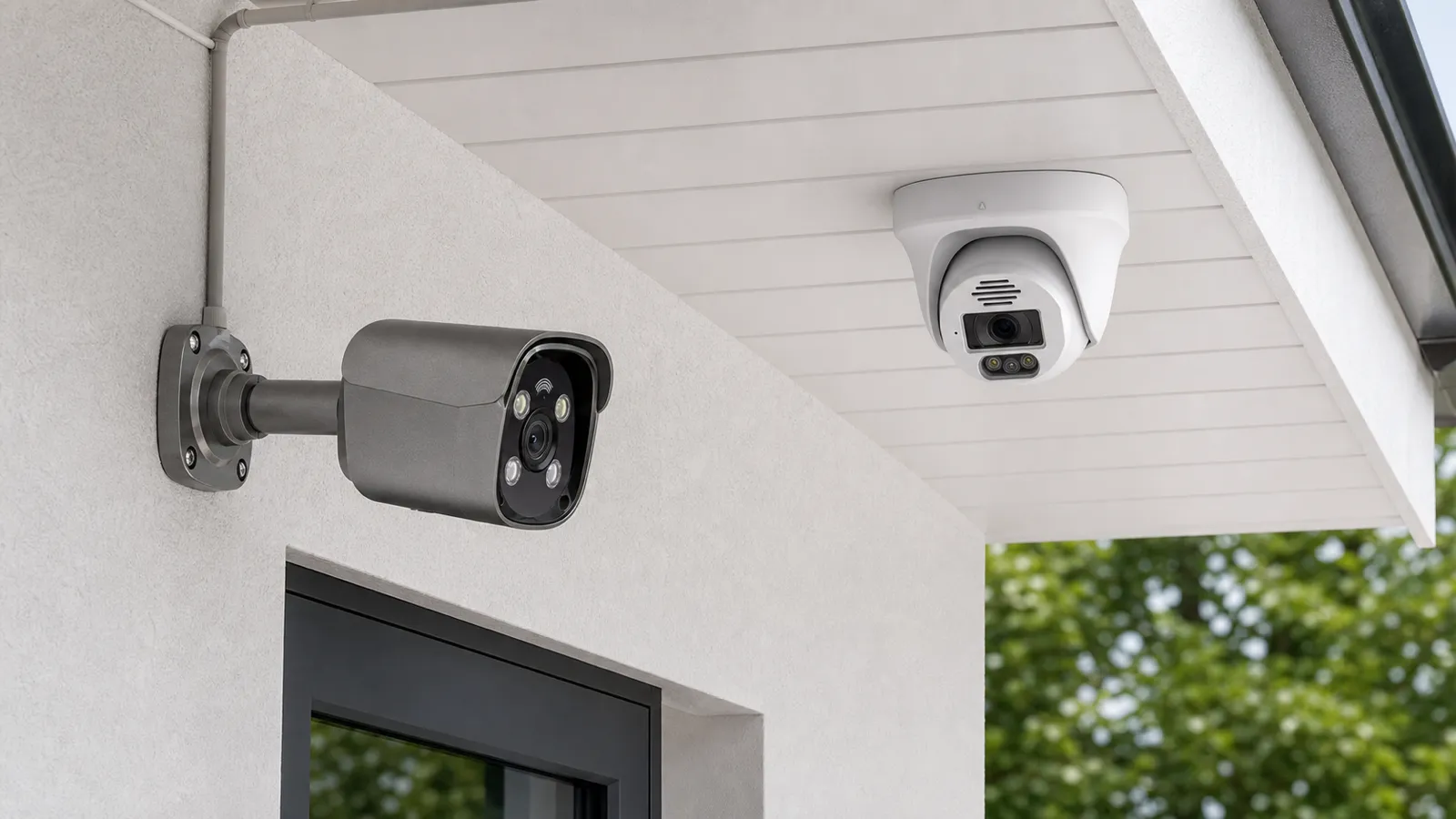
Bullet camera vs dome camera is a common comparison in CCTV and IP camera buying because both shapes are widely used in security surveillance. A bullet camera has a visible cylindrical or rectangular body that points in a clear direction. A dome camera places the lens inside a dome-shaped housing, often with a more compact and less directional appearance. Both designs can be used as PoE camera models, outdoor security camera models, night vision camera models, and part of an NVR security system.
The difference goes beyond appearance. The camera shape affects deterrence, mounting location, tamper resistance, lens adjustment, weather exposure, cleaning, infrared reflection, and user perception. A home security camera buyer may care about appearance and ease of aiming. A business surveillance system buyer may care about durability, vandal resistance, and whether customers can easily see where the camera is pointed.
The form factor should follow the location. A camera that works well on a warehouse wall may look wrong in a clinic lobby, and a clean indoor dome may be a poor fit for a dusty gate.
How it works
A bullet camera uses a housing that extends outward from the mounting surface. It is usually mounted on a wall, pole, or ceiling bracket. The lens direction is visually obvious, which can support deterrence because people can see that the area is being monitored. Bullet cameras often include sun shields, larger housings, long-range infrared LEDs, and easier access for lens adjustment.
A dome camera uses a rounded housing. The camera module is inside the dome and can be adjusted to point in the desired direction. Dome cameras may be mounted on ceilings, soffits, walls, or junction boxes. Some models are vandal-resistant with impact-rated housings. Because the lens direction may be less obvious, dome cameras are often chosen for indoor retail, office, lobby, school, and public-facing locations where a more discreet appearance is desired.
Both bullet and dome designs can use similar internal technology. Either one may be a 4MP, 5MP, or 8MP IP camera. Either one may support PoE, H.265 compression, wide dynamic range, infrared night vision, AI surveillance, audio, microSD storage, or ONVIF interoperability. The form factor does not determine image quality by itself. Instead, it affects installation and scene suitability.
Outdoor performance depends on the housing design. Bullet cameras often shed water and dust more easily because the lens window is exposed forward and the body may include a visor. Dome cameras can be weatherproof, but water droplets, dust, spider webs, or scratches on the dome can affect image quality, especially when infrared LEDs reflect inside or across the dome.
Tamper resistance is another difference. A low-mounted bullet camera may be easier to grab, twist, or redirect unless it is mounted securely. A vandal-resistant dome camera can be harder to manipulate because the lens is protected by the dome cover. However, dome covers can be scratched or damaged if installed in high-risk areas.
Features to compare
Deterrence and discretion are the main visual tradeoff. Bullet cameras are more visible and directional. They tell people that surveillance is present and show the watched direction. Dome cameras are less visually aggressive and blend more easily into ceilings or business interiors.
Aiming and maintenance also differ. Bullet cameras are generally easy to aim after installation because the body direction is visible. Dome cameras require opening or adjusting the internal module, and the installer needs to avoid fingerprints or dust on the dome cover. On larger projects, that extra handling time can matter.
Infrared behavior is easy to overlook until the first night test. Many night vision camera models place IR LEDs around the lens. On dome cameras, scratches, dust, water droplets, or an improperly seated foam ring can cause IR reflection, creating haze or glare at night. Bullet cameras can also have IR problems, especially with nearby walls or insects, but internal dome reflection is less of a concern.
Mounting height changes how each shape behaves. Dome cameras are common on ceilings and soffits because they look natural overhead. Bullet cameras are common on exterior walls, fence lines, gates, and perimeter views. Both can work in either location if the mounting bracket and viewing angle are appropriate.
Environmental exposure should be checked by rating, not by shape alone. A bullet camera with a sun shield may handle direct sun and rain well when mounted correctly. A dome camera may be better in sheltered areas or under eaves, although many outdoor dome models are designed for exposed installation. Buyers still need to check ingress protection, operating temperature, and impact rating.
Match equipment to the site requirements
Start with the camera's purpose. If the goal is visible deterrence at a driveway, warehouse door, side gate, or loading dock, a bullet camera can be a strong choice. Its direction is obvious, and the housing can support longer lenses or stronger IR designs. If the goal is indoor monitoring with a cleaner appearance, a dome camera may fit better.
Consider tamper risk. In public corridors, retail spaces, schools, elevators, or low-ceiling areas, a vandal-resistant dome camera can reduce the chance of someone changing the aim. For exterior wall mounting above reach height, bullet cameras can be practical and easy to service.
Think about night performance. If the camera will use infrared in complete darkness, dome cleanliness and installation quality are important. For dusty, insect-heavy, rainy, or coastal areas, bullet or turret-style cameras are often easier to keep clear. If a dome camera is selected, the installer should ensure the dome cover is clean and the IR isolation ring is correctly seated.
Evaluate aesthetics and customer perception. In a boutique retail store, clinic, office, or hotel lobby, dome cameras may be less intrusive. In a warehouse yard or parking lot, visible bullet cameras may be preferred because they reinforce that the area is monitored.
Match the lens and resolution to the scene. A bullet camera vs dome camera decision should not replace proper camera planning. A dome with the right varifocal lens can outperform a bullet with the wrong wide-angle lens, and the reverse is also true. Buyers should still define target distance, field of view, lighting, storage, and NVR compatibility.
Installation accessories can decide whether the finished job is clean and durable. Junction boxes, wall mounts, pole mounts, corner mounts, conduit adapters, and weatherproof cable glands are not minor details on outdoor projects.
Common Applications
Bullet cameras are often used outdoors at building corners, parking lots, gates, fence lines, loading docks, driveways, alleys, and warehouse exteriors. They are also common in agricultural sites, workshops, and perimeter monitoring where a visible outdoor security camera is desirable.
Dome cameras are common indoors in retail stores, offices, schools, hotels, apartment corridors, elevators, restaurants, and reception areas. They are also used under eaves and covered entrances when a more discreet appearance is preferred.
In a PoE security camera system, both form factors may connect to the same PoE switch or PoE NVR. A site might use bullet cameras for exterior perimeter coverage and dome cameras for interior public areas. This mixed approach is often more effective than choosing only one form factor.
For AI surveillance, either form factor can support human detection, vehicle detection, intrusion zones, or line crossing when the camera model includes those functions. The analytics performance depends on view angle, mounting height, target size, lighting, and algorithm quality, not just housing shape.
Common Problems
One common problem with dome cameras is night haze caused by IR reflection. Dust, fingerprints, water spots, scratches, or a displaced internal foam ring can reflect infrared light into the lens. This can make the image look foggy even when the camera is working.
Bullet cameras can have glare problems if mounted too close to a wall, soffit, or reflective surface. The IR beam may bounce back into the lens. A slight repositioning or bracket extension can improve performance.
Another issue is using a visible bullet camera where a discreet design would be better. In some customer-facing interiors, a large bullet camera can feel too industrial. Conversely, using a subtle dome camera at a high-risk exterior gate may reduce deterrence.
Maintenance is often underestimated. Spider webs, dust, rain marks, and insects can affect both designs. Outdoor cameras should be mounted so they can be safely cleaned and serviced.
Some buyers assume dome means vandal-proof. Only models with appropriate impact ratings and proper mounting provide real resistance. A low-cost plastic dome should not be treated as a high-security enclosure.
FAQ
Is a bullet camera better than a dome camera?
Neither is universally better. Bullet cameras are visible, easy to aim, and common outdoors. Dome cameras are discreet, compact, and often better for indoor or tamper-sensitive areas.
Which camera is better for night vision?
Both can work well. Bullet cameras often avoid internal dome reflection, while dome cameras require careful cleaning and installation to prevent IR haze.
Which is better for business surveillance?
Many businesses use both: bullet cameras outside and dome cameras inside. The right choice depends on location, deterrence, appearance, and tamper risk.
Can bullet and dome cameras connect to the same NVR?
Yes, if they are compatible IP cameras or supported by the recorder. A PoE NVR security system can record different camera shapes at the same time.
Which is more vandal-resistant?
Vandal-resistant dome cameras are often better in reachable areas, but buyers should check impact ratings and mounting quality.
How QuarkView Can Help
Camera shape is only one part of placement, so this guide works best alongside IP camera buying guide, outdoor security camera installation guide, night vision security camera guide, and PTZ camera technology guide when deciding what each location needs to see and how visible the camera should be.
For QuarkView product matching, compare single PoE cameras, PoE camera systems, and mounting and camera accessories after you decide whether the location calls for a visible deterrent, a lower-profile camera, or extra mounting hardware.
QuarkView note: QuarkView recommends choosing bullet or dome cameras by scene, mounting height, tamper risk, and visibility rather than treating one camera shape as universally better.
Summary
Bullet camera vs dome camera is mainly a form-factor and installation decision. Bullet cameras are visible, directional, and practical for many outdoor security camera locations. Dome cameras are compact, discreet, and useful in indoor or tamper-sensitive environments. Image quality depends on the internal camera, lens, sensor, lighting, and recording settings. Many surveillance systems use both camera types because each solves a different installation problem.
Reference Sources
- ONVIF Profiles for IP camera and recorder compatibility concepts.
- IEC 60529 overview from IEC for ingress protection rating context.
- NEMA Enclosure Types for environmental enclosure classification context.
- NIST IR 8259A for cybersecurity capabilities in connected devices.
- CISA IoT Security for connected camera security practices.