
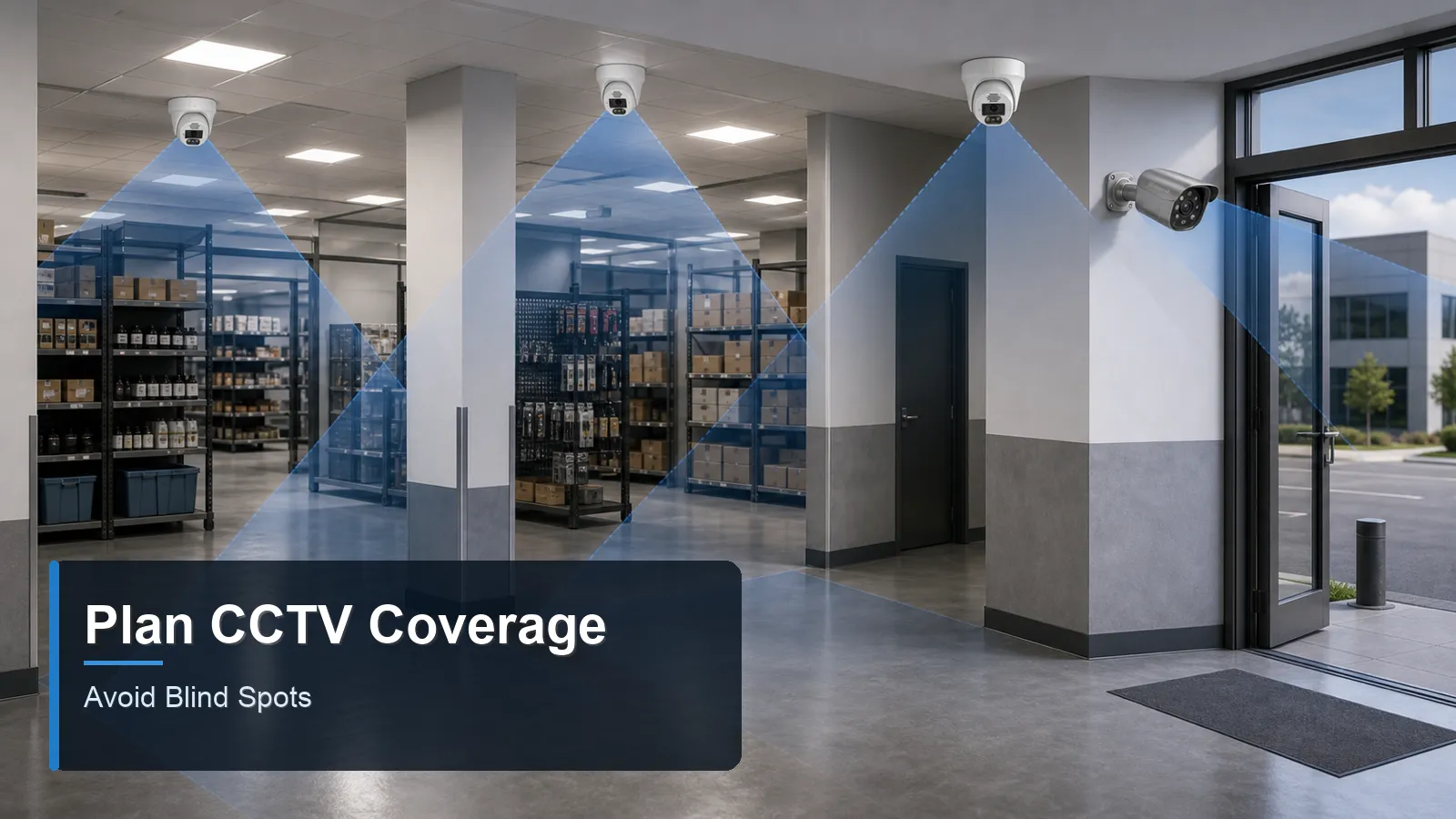
CCTV blind spots are areas that the security camera system cannot see well enough for the intended purpose. A blind spot may be completely invisible, partly blocked, too dark, too bright, too distant, or visible only with too little detail. A buyer may see many camera thumbnails on the NVR monitor and assume the building is covered, but important activity can still happen outside the useful field of view.
Blind spot planning is part of security camera system design. It requires a site map, camera purpose, lens selection, mounting height, lighting review, and final walk test. A CCTV camera in a corner may provide room context, while a second IP camera at an entrance may provide identification detail. A PoE camera makes cable and power planning easier, but it does not solve poor viewing geometry by itself.
How it works
The first step is to define the required level of detail. Detection means knowing that a person or vehicle is present. Observation means understanding what is happening. Recognition means a familiar person or object may be recognized. Identification means the image may support comparison of a person's identity. These levels are often discussed through pixel density and DORI-style planning, but the practical message is simple: a wide view is not the same as a useful evidence view.
The second step is to map sight lines. Draw the camera position, field of view, and expected movement path. Then add physical obstructions such as walls, columns, doors, pallet racks, parked vehicles, trees, display shelves, and signs. In a wired surveillance system, the best camera location may not be the easiest cable path. Design should balance cable practicality with evidence value.
Common CCTV blind spot causes and corrections
Blind spot cause
Why it happens
Correction method
Acceptance test
Obstruction
Columns, shelving, parked vehicles, signs, or landscape block the view
Move the camera, add a second angle, or narrow the target zone
Walk the expected route and confirm continuous visibility
Wrong lens
A wide lens lacks detail or a narrow lens misses nearby context
Match focal length to target distance and required detail
Check face or object detail at the farthest important point
Poor mounting angle
Camera is too high, too steep, or aimed across a doorway
Lower or re-aim for face direction and entrance path
Review recorded video of a person entering and exiting
Lighting contrast
Backlight, headlights, IR reflection, or shadows hide detail
Adjust angle, add lighting, use WDR, or change camera position
Test in daytime, nighttime, and peak lighting conditions
The third step is to use overlap intentionally. Overlap does not mean duplicating every view. It means using two angles where a person or vehicle could otherwise disappear at a critical point. For example, a parking lot corner may need one outdoor security camera for approach context and another narrower camera for the gate or loading door. A hallway may need two opposing views if one direction is backlit.
The fourth step is to test conditions. Many blind spots appear only at night, during rain, when vehicle headlights face the lens, or when the sun hits a glass entrance. Infrared reflection from walls, dome covers, or nearby signs can make night footage cloudy. WDR can help with strong backlight, but it cannot fix every angle. A final acceptance test should include recorded playback, not only live viewing.
The fifth step is to document the result. Save a camera map, capture representative daytime and nighttime snapshots, and record the target distance for every detail view. If a buyer later changes shelving, parking arrangements, door hardware, or lighting, this record makes it easier to understand whether the original CCTV blind spot assessment is still valid. Documentation also helps a remote supplier or maintenance team diagnose problems without visiting the site.
The QuarkView Knowledge Base recommends treating every blind spot as a design question: what object blocks the view, what evidence is required, and which camera angle solves the problem with the least unnecessary coverage?
Features to compare
Field of view is the width and height of the scene a camera captures. Focal length, sensor size, and mounting position define the field of view. A 2.8mm lens may be useful for a broad interior, while a 6mm lens may be better for a door or narrow driveway.
Pixel density is the amount of image detail placed on the target. Higher resolution helps only when the lens and distance place enough pixels on the subject. This is why an 8MP camera can still fail if it covers too wide an area.
Camera height should match the purpose. High cameras reduce tampering and show layout. Lower, protected cameras can improve face capture. Entrances often need a more direct angle than general overview positions.
Lighting design is part of coverage. Night vision range, IR angle, WDR, white light, and ambient lighting all affect blind spots. A bright doorway can be as difficult as a dark corridor.
Check viewing distance and recorded detail
Ask for a camera layout before approving a quotation. The layout should show camera position, view direction, lens, mounting height, and intended purpose. If the drawing only lists a camera count, it does not prove that CCTV blind spots have been addressed.
Choose camera lenses according to distance. A wide camera may look attractive because it shows more area, but it may not provide the detail needed for an entrance or cash area. A narrower lens may require more cameras, but it can make footage more useful.
Consider maintenance and physical protection. A camera that solves a blind spot but cannot be reached for cleaning or adjustment may create long-term problems. Outdoor cameras should have protected connectors, suitable weather ratings, and stable mounting surfaces.
For an NVR security system, confirm that additional blind-spot cameras can be recorded at the planned quality. Adding cameras without increasing surveillance storage may shorten retention below the buyer's requirement.
Request an acceptance walk-through. One person should move through important paths while another person checks the recorded timeline on the NVR. The test should include entering, leaving, carrying objects, opening doors, and walking near known obstructions. If the person disappears from every useful view at a critical point, the design still has a blind spot.
Common Applications
Retail stores use blind spot planning around shelves, checkout counters, entrances, and stock-room doors. A camera over the sales floor may not see behind displays, so targeted cameras may be needed at high-risk areas.
Warehouses need special attention around pallet racks, loading docks, forklift paths, and exterior yards. Camera height and lens choice should allow operators to understand movement without losing detail at doors.
Residential projects often have blind spots at side gates, garage corners, porch recesses, and garden paths. A PoE security camera system can support added cameras if the NVR channel count and cabling are planned early.
Common Problems
The first problem is relying on a single wide view for a complex area. The image may look impressive on a phone, but the footage may not identify a person at the far edge of the scene.
The second problem is ignoring moving obstructions. Parked vehicles, open doors, seasonal plants, stacked boxes, and temporary displays can create blind spots after installation.
The third problem is testing only during the day. Night IR reflection, shadows, rain, and headlights may reveal coverage failures that are invisible during daytime acceptance.
FAQ
What is a CCTV blind spot?
It is any area that is not visible or not visible with enough detail for the camera's intended purpose.
Can I remove all blind spots?
Not always, but you can reduce critical blind spots by defining priority areas, using overlap, and testing real movement paths.
Does a wide-angle lens prevent blind spots?
It can reduce unseen area, but it may reduce detail. Wide coverage and identification detail often require separate cameras.
Should cameras overlap?
Yes, where a person or vehicle could disappear at a critical point. Overlap should be purposeful, not random duplication.
How do I test for blind spots?
Walk the site while recording, then review playback from every camera at daytime and nighttime conditions.
Summary
Planning CCTV coverage without blind spots requires more than buying enough cameras. It requires a defined purpose for each view, realistic lens selection, obstruction review, lighting tests, overlap at critical points, and NVR storage planning.
The strongest designs are reviewed again after furniture, stock, vehicles, lighting, or building use changes because blind spots can appear after the original installation.
Prepared for international buyers by the QuarkView Security Learning Center, this guide supports CCTV camera placement, IP camera field-of-view planning, PoE camera installation, NVR security system sizing, wired surveillance system documentation, surveillance storage, outdoor security camera testing, and business surveillance system review.
Plan Your Security Camera System With QuarkView
If you are comparing CCTV blind spot planning, coverage cones, columns, corridor corners, and camera placement strategy, explore related QuarkView products or contact QuarkView for project and volume inquiry support.
Related QuarkView Planning Resources
For the next planning step, compare How Many Security Cameras Do You Need for a Building?, Panoramic Security Cameras: 180-Degree and 360-Degree Surveillance Explained, Security Camera Power Supply Guide: PoE, DC Power, and Power Adapters, PoE Switch Basics for Security Camera Systems, Smart Motion Alerts in Security Camera Systems. These related guides connect product selection, placement, recording, installation, and long-term reliability decisions.
Related QuarkView Collections
Reference Sources
- Axis Communications. Pixel density and DORI. Source link (https://whitepapers.axis.com/en-us/pixel-density-and-dori)
- Axis Communications. Lenses in surveillance. Source link (https://whitepapers.axis.com/en-US/lenses-in-surveillance)
- UK Information Commissioner's Office. Video surveillance including CCTV guidance. Source link (https://ico.org.uk/for-organisations/uk-gdpr-guidance-and-resources/cctv-and-video-surveillance/guidance-on-video-surveillance-including-cctv/)
- ONVIF. ONVIF Profiles for IP-based physical security products. Source link (https://www.onvif.org/profiles/)
- Western Digital. Surveillance / CCTV storage capacity estimator. Source link (https://www.westerndigital.com/solutions/surveillance)